In aerodynamics, the flight envelope defines operational limits for an aerial platform with respect to maximum speed and load factor given a particular atmospheric density. The flight envelope is the region within which an aircraft can operate safely. The V-g diagram leads you to cornering speed and that allows you to extract maximum performance from your aircraft without breaking it.
If an aircraft flies ‘outside the envelope’ it may suffer damage; the limits should therefore never be exceeded. The term has also been adopted in other fields of engineering when referring to the behaviour of a system which is operating beyond its normal design specification, i.e. ‘outside the flight envelope’ (even if the system is not even actually flying).
Visual Representation. There are several types of aircraft flight envelope diagram, normally depicting the relation between one flight parameter and another. The most common diagram includes airspeed (normally expressed in Mach) and flight altitude variation (V-h) or airspeed and load variation (V-n).
This second diagram is the most important and common plot used as it shows structural load limits as a function of airspeed. This flight envelope is normally defined during the design phase. A chart of speed versus load factor (or V-n diagram) is a way of showing the limits of an aircraft’s performance. It shows how much load factor can be safely achieved at different airspeeds.
The definition and analysis of the V-n diagram is critical during the design of an aircraft as it affects the operation of the aircraft. A manoeuvre or gust of wind may temporarily force an aircraft outside its safe flight envelope and thereby cause structural damageendangering flight safety.
V-n FLIGHT ENVELOPE
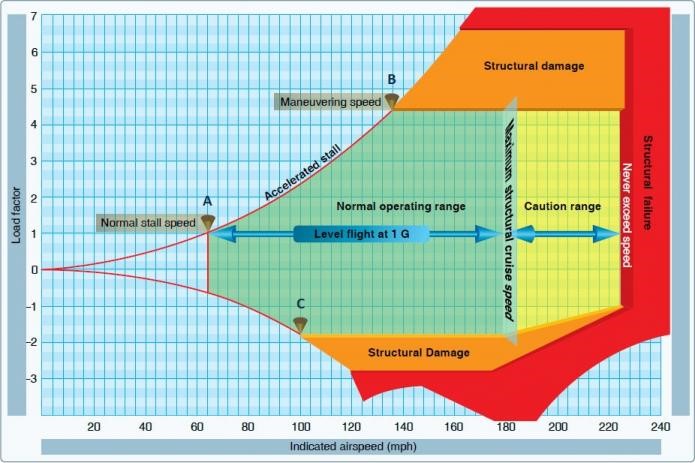
The following is a basic V-n diagram (sometimes referred to as a V-g diagram) including the most important features of such diagrams. The diagram does not belong to a specific airplane. In this example the V-n diagram represents airspeed (horizontal axis) against load factor (vertical axis). In more complex aircraft the diagram may vary.
Typical V-n diagram
Load Factor. An aircraft structure is designed to be able to withstand the forces exerted upon it during flight; together, these forces are calculated as the load factor and may vary depending on the phase of flight; the load factor is defined as the relationship between lift and the weight of the aircraft:
where
n = Load factor
L = Lift
W = Weight
The load factor is equal to 1 when the aircraft is static on the ground, with only gravity acting upon it. The load factor can therefore be defined as a multiple of gravitational acceleration g.
There are various important features of the V-n diagram:
– The normal stall speed (point A) is defined by the aerodynamic characteristics of the platform. In the example above the aircraft is capable of developing n=1 (1g) at 62 mph, which is the wing level stall speed of the aircraft.
– The intersection of the positive limit of the load factor and the line of maximum lift (point B) defines the maximum airspeed that allows full manoeuverability. This point is called the manoeuver speed or corner speed. At lower speeds, the structure cannot be overstressed as it will stall before reaching the limit load factor. At the manoeuver airspeed the aircraft’s limit load factor will be reached at the lowest possible airspeed. At higher speeds, possible structural damage may be caused. In the diagram above, the manoeuvering speed is reached in n=4.4g and IAS=137 mph.
– The intersection of the negative limit load factor and line of maximum negative lift capability (point C) defines the maximum airspeed that allows full manoeuverability in a negative lift situation. As the graph shows, airspeeds greater than point C provide sufficient negative lift to damage the structure.
– The airspeed necessary to produce a given negative load factor is higher than that to produce the same positive load factor.
– To ensure structural safety, a maximum structural cruise speed should be defined. It is normally defined as a reference point for every aircraft; in the example above it is 180mph. Additionally, the diagram defines the never exceed speed or diving speed. This is the maximum speed (normally 1.25 Cruise speed) before the aircraft enters the region where structural failure is possible
– When an aircraft is operated in the regions called Structural Damage or Structural Failure, unacceptable permanent deformation of the primary structure and a high rate of fatigue may take place. Operation above the limit load factor must therefore be avoided in normal operation.
[smartslider3 slider=”2″]
MONTREAL (AP) — Canadian aerospace company Bombardier has announced the sale of its regional jet program to Japan’s Mitsubishi Heavy Industries Ltd. for $550 million.
It was one of the world’s newest and best passenger planes: sleek, reliable and ultra-modern, a revamped version of the best-selling aircraft in history.
Hundreds of Boeing 737 MAX jets flew thousands of passengers hour after hour, day after day, by many of the world’s top airlines, with hundreds more on order.
And then, suddenly, two of those planes went rogue.
The crashes of a Lion Air MAX in October, which killed all 189 people on board, and an Ethiopian Airlines MAX in March, which killed 157, happened at a time air travel has never been safer.
Both planes fell out of the sky minutes after takeoff, seemingly without warning.
But investigations into the crashes and intense scrutiny of Boeing’s MAX have cast serious doubts about its safety, stability and track record, suggesting warning signs were there all along.
And while MAX jets have been temporarily grounded worldwide in the wake of the twin tragedies, it seems many pilots wouldn’t want to fly them anyway.
60 Minutes revealed disturbing new information about the Boeing 737 MAX, the plane at the centre of what it calls “the world’s biggest aviation scandal”, as well as fresh concerns from pilots and aviation experts about the safety of the aircraft.
Journalist Liz Hayes took a look inside the cockpit to learn more about the aircraft’s anti-stall system, MCAS, which has been implicated in both crashes.
MCAS is believed to have played a role in both planes flying erratically and suddenly pitching down to their doom mere minutes after takeoff.
“It’s got a mind of its own,” Hayes says in the cockpit in a preview of Sunday’s program.
Hayes was told how the MAX crashes “were not the pilots’ fault at all”.
“There was a system on the aircraft which we had no knowledge of,” one airline pilot told 60 Minutes.
“It wasn’t in our books. We hadn’t been trained to it. It was absolute blindfold in a dark forest for us.”
Another aviation expert said the MAX disasters were “Kamikaze stuff”.
Veteran aircraft pilot Chris Brady said pilots were terrified Boeing let other issues slip through.
“What else has got through?” he said. “What else could be on board that we haven’t seen yet?”
Boeing MAX 8 and 9 planes have been grounded since March, when nations worldwide, including Australia, banned the aircraft from their airspace.
The worldwide response followed the Ethiopian Airlines disaster on March 10.
A huge concern for aviation regulators, Boeing and the travelling public comes from the eerie parallels between it and the Lion Air crash in Indonesia less than six months earlier.
Both crashes involved almost brand-new 737 MAX 8 jets. Both flights crashed within minutes of takeoff. And both planes experienced erratic flight after takeoff, with both pilots asking to turn back to the origin airport.
Sources familiar with the Lion Air cockpit voice recordings have reported the pilots frantically flicked through the plane’s manual to try to understand why the plane was lurching downwards in its final moments.
Pilots of the doomed Ethiopian Airlines plane followed Boeing’s emergency procedures when the plane began to pitch down but could not regain control of it.
A possible link between both crashes involves the MCAS anti-stalling system. The feature was added to the MAX planes because the nose tends to pitch up in flight — sensors tell the MCAS to pitch the nose down.
As both pilots apparently had trouble controlling the erratically flying planes, experts are probing whether a faulty angle-of-attack (AoA) sensor was involved.
This week CNN revealed the angle-of-attack sensor was flagged in at least 216 incident reports submitted to the US Federal Aviation Administration.
However, despite the recorded incidents, Boeing did not flight test a scenario — such as an accidental nosedive — in which the sensor malfunctioned, CNN reported.
A source told CNN the failure of an AoA sensor was not flight tested and instead was “analysed in the design and certification” of the aircraft. It was determined trained pilots would have been able to handle the failure if it were to happen.
“I would be very curious to know what their logic was on that … and what drove them to think that was a suitable solution,” a former Boeing test pilot told CNN.
Union groups have claimed pilots weren’t properly trained on the feature, which added to the 737 MAX and not on the original 737 planes.
Just last week, pilots said new training for MAX aircraft proposed by Boeing didn’t go far enough in addressing their concerns about the aircraft.
Boeing has proposed computer-based training for pilots to better understand MCAS, rather than simulation time, Reuters reported.
But last week the US Allied Pilots Association, which represents pilots at American Airlines — one of the biggest 737 MAX operators in the US — said computer explanation would “not provide a level of confidence for pilots to feel not only comfortable flying the aircraft but also relaying that confidence to the travelling public.”
It’s still at the conceptual stage, but a new supersonic airplane design unveiled this week by Lockheed Martin Aeronautics could be the clearest indication yet that we’re on the brink of a new golden age of super-fast air travel.
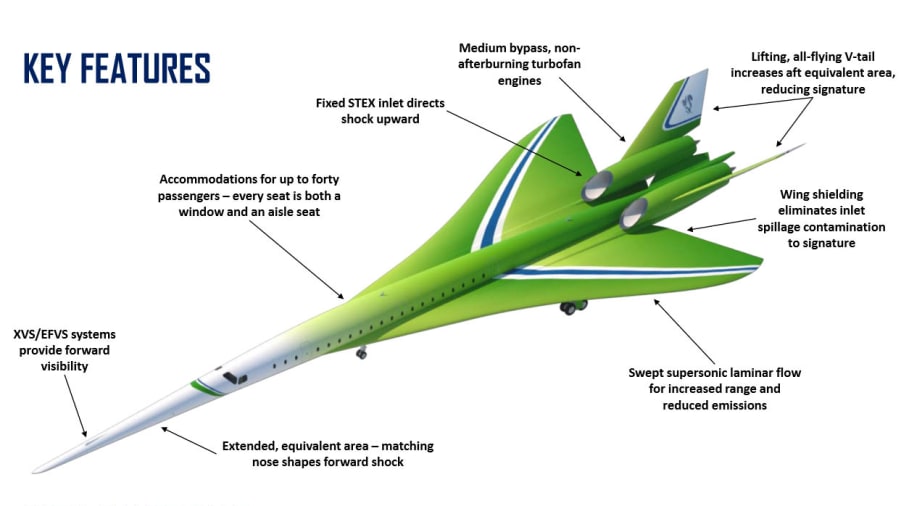
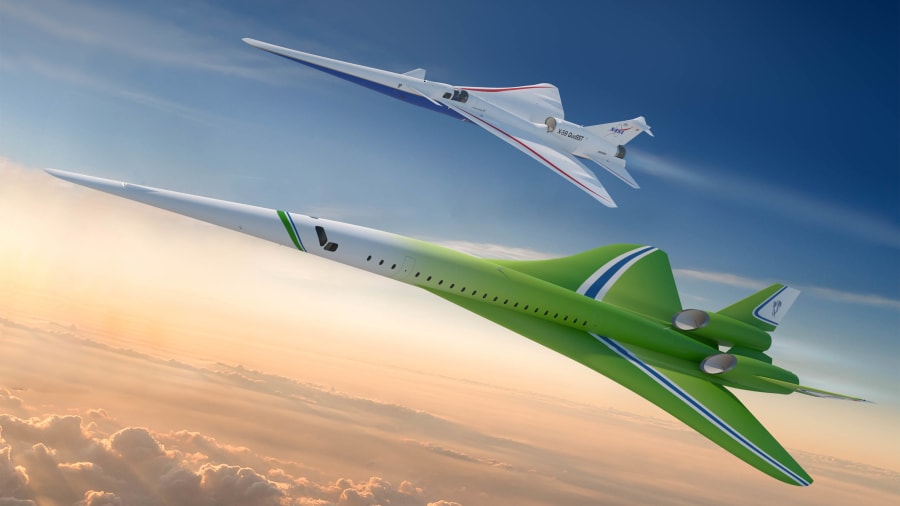
The Quiet Supersonic Technology Airliner, a sleek twin-engined jet plane that will carry up to 40 passengers at speeds of Mach 1.8, was revealed on Wednesday at an American Institute of Aeronautics and Astronautics conference in Dallas.
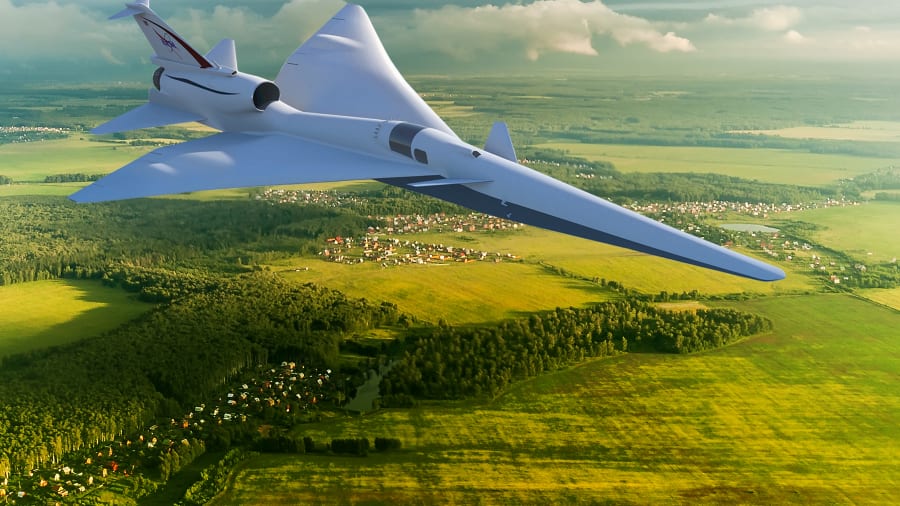
Though still a ways off being built, the design leverages Lockheed Martin’s work with NASA to create the X-59 Quiet SuperSonic Technology X-plane — a supersonic jet that does not create the intense sonic boom typically associated with aircraft breaching the sound barrier.
The loud noise created by Concorde when it crossed the Mach 1 speed threshold prevented the aircraft from operating over-land routes, greatly reducing its economic viability.
Lockheed Martin says, because there are tests underway on X-59 that could pave the way for a rethinking of regulations that prevent overland supersonic flight, it wanted to be ready with a commercial aircraft that could capitalize on newly opened routes.
But Mike Buonanno, the LM aerospace engineer who briefed AIAA on the concept, says the technology is pretty much in place to go ahead once the concept is proved from NASA’s X-59 program.
“Right now, we’ve only done early conceptual design studies to establish that the design is feasible, do sizing for the concept, how big it should be, how much it should weigh… Those early sensitivity studies to make sure it all makes sense,” he tells CNN Travel.
The QSTA isn’t the only new commercial supersonic passenger jet on the drawing table right now. US startup Boom Supersonic has attracted a $10 million investment from Japan Airlines and reportedly dozens of pre-orders for its envisioned 55-seat jet capable of Mach 2.2.
Yet, with overland supersonic boom restrictions in place, it will take radical design work and a major regulatory shakeup before some of the planet’s most popular air routes are opened up to full faster-than-the-speed-of-sound aviation.
Lockheed Martin’s design is reminiscent of Concorde’s delta-wing design, but instead utilizes an extended super-sharp nose to sculpt sonic shockwaves that will cascade along the aircraft without the explosive bang created by its aeronautical ancestor.
If work on the X-59 successfully transfers across, the noise should be audible from the ground only as a thump similar to a car door being slammed.
While Concorde needed a hydraulic drooping nose to allow its pilots to see properly during landings, QSTA will use a technological solution: forward visibility systems embedded at the front to relay the required visuals to the cockpit.
The cabin is designed to accommodate 40 passengers in a single aisle configuration with one seat either side so that all passengers will have window and aisle access.
“Ultimately airlines determine how they arrange their seats, but we’ve nominally configured the airplane for 40 passengers,” says Buonanno. “We did considerable market research and found that this was the sweet spot for the size of this type of airplane, basically maximizing the number of markets that can be addressed by the airplane.”
At the rear of the airplane, there’s an unusual “flying V-tail” structure that replaces the standard single fin design usually seen on commercial aircraft with twin fin more often associated with fighter jets.
The QSTA’s power comes from two turbofan engines that, unlike Concorde, don’t feature afterburners that inject fuel directly into the engine to drastically ramp up thrust. These will provide the aircraft with 40,000 pounds of thrust at ground level.
The engine needs to be a new design,” says Buonanno. “We did a survey of what existing engines were out there, the conclusion of that survey was, we found, that there were no off-the-shelf engines that we could just drop on and use as-is for the airplane.
Buonanno adds that he’s confident that existing engine concepts could easily be adapted for the QSTA.
“There would be multiple modifications required,” he says. “Really you’d have to put what’s called a new low-pressure spool on the engine, a new fan and a new low-pressure turbine, but you’d be able to repurpose that very high-technology heart of the turbojet engine.”
The aircraft would, according to Lockheed Martin, have a range of about 5,200 nautical miles, easily covering routes such as New York-London, Tokyo-Los Angeles, London-Beijing and Tokyo-Sydney.
Projections indicate the time saving on a London-Tokyo flight of 5,190 miles would be 4 hours 30 minutes.
Buonanno says there’s no current estimations on when the QSTA, if it goes into production, would enter service since any move towards building would rely on the outcome of the X-59 testing program.
But he said there was optimism that the data needed to prompt a change in regulations for overland supersonic flight would be forthcoming.
“Right now the primary focus is to get that data to solve the regulatory challenge,” he says. “The goal is to get that data by 2023, there’s a rule-making cycle that goes on and we’re working towards that goal for supporting that mission.”
At a Facebook content moderation facility in Tampa, Florida, contractors working for Cognizant are regularly subjected to traumatizing, unsanitary, and dangerous conditions — that in at least one case literally led to a death. The contractors, who review as many as 200 flagged Facebook posts per day depicting animal abuse, sexual abuse, murder, and other horrifying acts, are subjected to hellish work conditions. That’s according to an investigation by The Verge‘s Casey Newton that reveals how tens of thousands of people spend their days exposed to the very worst that the internet has to offer.
Horror Stories
One such contractor had a heart attack at his desk, later dying in a hospital — in part, perhaps, because Cognizant doesn’t provide on-site defibrillators. The next day, management refused to tell the deceased contractor’s coworkers what happened, instead insisting that he would be fine while passing around a get-well card. Other employees broke their non-disclosure agreements to share how they had to work at filthy desks when they were violently sick because taking the day off would mean getting fired. Even more talked about how HR ignored or laughed-off reports of sexual harassment and violent threats. “I think Facebook needs to shut down,” one moderator told Newton.
Temporary Workforce
Ultimately, Newton concludes that massive platforms like Facebook and Google treat their armies of content moderators as disposable because they believe that artificial intelligence will someday be able to do the job for them.
Newton writes that the human moderators, many of whom walk away with PTSD, depression, and anxiety, are “viewed as a speed bump on the way to an AI-powered future.”
The European Space Agency is building Space Rider, a drone-shuttle capable not only of carrying experiments into space, but also of getting them back to Earth. The last verification of the project is scheduled for the end of 2019, while the first flight is scheduled for 2022.
With a 1,200-liter cargo area, the shuttle can carry up to 800 kg of experiments that require
canadian drugs online prescription, Canadian Pharmacies Mail Order buy propecia taiwan https://findpropecia.com/ cheapest online drugstore, propecia 5mg Pharmacy Shop
microgravity or other conditions that are difficult to replicate on Earth. The main feature of Space Rider, however, is its reusability: this “shuttle” is designed to make at least 6 trips, each of which can be long months.
The start is made with a Vega C rocket (also currently under development), but once in orbit Space Rider can use its on-board engines to change the set-up and move in the direction required by the experiment of round. Meanwhile it is supplied with energy by the solar panels of AVUM +, or the last stage of the rocket.
The start is made with a Vega C rocket (also currently under development), but once in orbit Space Rider can use its on-board engines to change the set-up and move in the direction required by the experiment. Meanwhile it is refuelled with energy by the solar panels of AVUM + (located at last stage of the rocket).
At the end of the mission AVUM + slows down the convoy and then separates: it cannot in fact return to the earth intact and is destined to burn in the atmosphere. Space Rider instead has a heat shield and uses the friction of the air to its advantage to slow down. After moving from a hypersonic speed to a subsonic one, it deploys a parachute similar to a glider, which will land it horizontally, ready to return the experiments to companies or research institutes that commissioned the launch.
Researchers from Nanyang Technological University, Singapore (NTU Singapore) and Griffith University in Australia have created a prototype quantum device that can generate all possible futures in a simultaneous quantum superposition.
If that sounds familiar you might be thinking of the scene in the 2018 film Avengers: Infinity War, where Dr. Strange looks into 14 million possible futures to search for a single timeline in which the heroes would be victorious.
“When we think about the future, we are confronted by a vast array of possibilities,” explains Assistant Professor Mile Gu of NTU Singapore, who led the development of the quantum algorithm that underpins the prototype. “These possibilities grow exponentially as we go deeper into the future. For instance, even if we have only two possibilities to choose from each minute, in less than half an hour there are 14 million possible futures. In less than a day, the number exceeds the number of atoms in the universe.”
Ambitious experiment ready to be scaled up
The researchers realized they could use a quantum computer to examine all possible futures by placing them in a quantum superposition.
The quantum superposition is something similar to the infamous Schrödinger cat, which is simultaneously alive and dead. Gu and his research team from Singapore joined up a group of experimental scientist from Griffith University. Led by Professor Geoff Pryde at Griffith University to test their theories.
Together the two teams implemented a specially devised photonic quantuminformation processor in which the potential future outcomes of a decision process are represented by the locations of photons aka quantum particles of light.
The ambitious researchers then demonstrated that the state of the quantum device was a superposition of multiple potential futures, weighted by their probability of occurrence.
Inspired by Feynman
“The functioning of this device is inspired by the Nobel Laureate Richard Feynman,” says Dr. Jayne Thompson, a member of the Singapore team.
“When Feynman started studying quantum physics, he realized that when a particle travels from point A to point B, it does not necessarily follow a single path. Instead, it simultaneously transverses all possible paths connecting the points. Our work extends this phenomenon and harnesses it for modeling statistical futures.”
The team says that their current prototype can simulate at most 16 futures simultaneously, but that the underlying quantum algorithm can in principle scale without bound. “This is what makes the field so exciting,” says Pryde.
“It is very much reminiscent of classical computers in the 1960s. Just as few could imagine the many uses of classical computers in the 1960s, we are still very much in the dark about what quantum computers can do. Each discovery of a new application provides further impetus for their technological development.”
On Wednesday (April 10), the international Event Horizon Telescope project will release the first results from its plan to image black holes. But what exactly is an event horizon?
The event horizon of a black hole is linked to the object’s escape velocity — the speed that one would need to exceed to escape the black hole’s gravitational pull. The closer someone came to a black hole, the greater the speed they would need to escape that massive gravity. The event horizon is the threshold around the black hole where the escape velocity surpasses the speed of light.
According to Einstein’s theory of special relativity, nothing can travel faster through space than the speed of light. This means a black hole’s event horizon is essentially the point from which nothing can return. The name refers to the impossibility of witnessing any event taking place inside that border, the horizon beyond which one cannot see.
“The event horizon is the ultimate prison wall — one can get in but never get out,” Avi Loeb, chair of astronomy at Harvard University, told Space.com.
When an item gets near an event horizon, a witness would see the item’s image redden and dim as gravity distorted light coming from that item. At the event horizon, this image would effectively fade to invisibility.
Within the event horizon, one would find the black hole’s singularity, where previous research suggests all of the object’s mass has collapsed to an infinitely dense extent. This means the fabric of space and time around the singularity has also curved to an infinite degree, so the laws of physics as we currently know them break down.
“The event horizon protects us from the unknown physics near a singularity,” Loeb said.
The size of an event horizon depends on the black hole’s mass. If Earth were compressed until it became a black hole, it would have a diameter of about 0.69 inches (17.4 millimeters), a little smaller than a dime; if the sun were converted to a black hole, it would be about 3.62 miles (5.84 kilometers) wide, about the size of a village or town. The supermassive black holes that the Event Horizon Telescope is observing are far larger; Sagittarius A*, at the center of the Milky Way, is about 4.3 million times the mass of our sun and has a diameter of about 7.9 million miles (12.7 million km), while M87 at the heart of the Virgo A galaxy is about 6 billion solar masses and 11 billion miles (17.7 billion km) wide.
The strength of a black hole’s gravitational pull depends on the distance from it — the closer you are, the more powerful the tug. But the effects of this gravity on a visitor would differ depending on the black hole’s mass. If you fell toward a relatively small black hole a few times the mass of the sun, for example, you would get pulled apart and stretched out in a process known as spaghettification, dying well before you reached the event horizon.
However, if you were to fall toward a supermassive black hole millions to billions of times the mass of the sun, you wouldn’t “feel such forces to a significant degree,” Loeb said. You would not die of spaghettification before you crossed the event horizon (although numerous other hazards around such a black hole might kill you before you reached that point).
Black holes likely spin because the stars they generally originate from also spun and because the matter they swallow whirled in spirals before it fell in. Recent findings suggest that black holes can rotate at speeds greater than 90 percent that of light, Loeb said.
Previously, the most basic model of black holes assumed they did not spin, and so their singularities were assumed to be points. But because black holes generally rotate, current models suggest their singularities are infinitely thin rings. This leads the event horizons of rotating black holes, also known as Kerr black holes, to appear oblong — squashed at the poles and bulging at their equators.
A rotating black hole’s event horizon separates into an outer horizon and an inner horizon. The outer event horizon of such an object acts like a point of no return, just like the event horizon of a nonrotating black hole. The inner event horizon of a rotating black hole, also known as the Cauchy horizon, is stranger. Past that threshold, cause no longer necessarily precedes effect, the past no longer necessarily determines the future, and time travel may be possible. (In a nonrotating black hole, also known as a Schwarzschild black hole, the inner and outer horizons coincide.)
A spinning black hole also forces the fabric of space-time around it to rotate with it, a phenomenon known as frame dragging or the Lense-Thirring effect. Frame dragging is also seen around other massive bodies, including Earth.
Frame dragging creates a cosmic whirlpool known as the ergosphere, which occurs outside a rotating black hole’s outer event horizon. Any object within the ergosphere is forced to move in the same direction in which the black hole is spinning. Matter falling into the ergosphere can get enough speed to escape the black hole’s gravitational pull, taking some of the black hole’s energy with it. In this manner, black holes can have powerful effects on their surroundings.
Rotation can also make black holes more effective at converting any matter that falls into them into energy. A nonrotating black hole would convert about 5.7 percent of an infalling object’s mass into energy, following Einstein’s famous equation E = mc^2. In contrast, a rotating black hole could convert up to 42 percent of an object’s mass into energy, scientists have determined
“This has important implications for the environments around black holes,” Loeb said. “The amount of energy from the supermassive black holes at the centers of virtually all large galaxies can significantly influence the evolution of those galaxies.”
Recent work has greatly upset the conventional view of black holes. In 2012, physicists suggested that anything falling toward a black hole might encounter “firewalls” at or in the vicinity of the event horizon that would incinerate any matter falling in. This is because when particles collide, they can become invisibly connected through a link called entanglement, and black holes could break such links, releasing incredible amounts of energy.
However, other research seeking to unite general relativity, which can explain the nature of gravity, with quantum mechanics, which can describe the behavior of all known particles, suggests that firewalls may not exist — because event horizons themselves may not exist. Some physicists suggest that instead of abysses from which nothing can return, what we currently think of as black holes may actually be a range of black-hole-like objects that lack event horizons, such as so-called fuzzballs, Loeb said.
By imaging the edges of black holes, the Event Horizon Telescope can help scientists analyze the shapes and behaviors of event horizons.
“We can use these images to constrain any theory on the structure of black holes,” Loeb said. “Indeed, the fuzzball speculation — where the event horizon is not a sharp boundary, but is rather fuzzy — could be tested with images from the Event Horizon Telescope.”
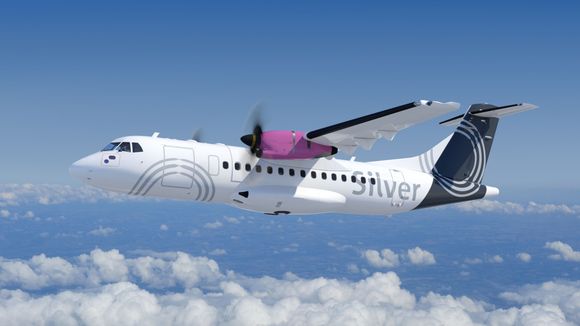
ATR is working on accumulating launch orders for its proposed short-field version of the ATR 42-600, estimating a market of 800 aircraft over 30 years.
Key potential buyers will be airlines serving islands with short runways, ATR head of region, Asia-Pacific, Christophe Potocki said.
The new version, the ATR 42-600S, is being designed to fly from 800-m (2,600-ft.) runways. ATR is looking to achieve this without great development expense. Changes are being made to operation of flaps, spoilers, the rudder and brakes. Potocki said empty weight will be reduced by installing lighter seats and galley fittings—but not by altering the structure.
The market for 800 aircraft is estimated by including all aircraft with 20–42 seats. Cargo delivery into locations with only short runways is also seen as a source of demand.
No precise number of aircraft in the launch orders is needed; rather, ATR will consider the quality of the customers, as well as the size of their commitments. The manufacturer is looking for a mix of airline and lessor customers, Potocki said. Orders could be announced at the Paris Air Show and a first delivery made 2–3 years after the launch of development, he said.
Earlier this decade, ATR,, owned by Airbus and Leonardo, studied how to offer a larger turboprop; it finally decided not to do so, but the possibilities indicate what may eventually emerge. One option was to further extend the aircraft from its ATR 72 length, which is sized for 70 economy seats at 30 in. pitch. Stretching is usually relatively inexpensive, but the ATR is already close to a hard limit on body length: it has a required rotation angle, which the short main landing gear cannot provide if the fuselage is too long. Three rows, and therefore 12 seats, can be added to the ATR 72—but no more without unacceptable reduction in the maximum tilt of the aircraft on takeoff, Potocki said.
Getting only three rows may be desirable, but Potocki added that even that modest stretch would demand more power and therefore costly engine development. The ATR 72 is notable for its high (and economical) power loading: 6.2 kg per kW (10.2 lb. per hp.) at gross weight. Evidently, this can barely be pushed higher. The type uses the Pratt & Whitney Canada PW127 engine.
The other path to offering larger capacity was developing a new type, called the New Generation Turboprop (NGTP). Potocki said it would have had a body sized for five-abreast economy seating. Although some five-abreast aircraft have around 90 seats, that width is also associated with maximum seating well above 100.
Airbus opposed development of the NGTP, noting that the ATR 72 was already dominant in its market.
A larger aircraft is, however, coming to the turboprop market—from Avic. The Chinese state company’s MA700, due for first delivery in 2022, is sized for 78 seats at 31 in. pitch.