Airbus is developing the A321XLR, an 8,700km range variant of its A320neo family. The twinjet aircraft will be able to fly 15% further than the current longest-range A320 variant, the A321LR, which has a range of 7,400km and can carry up to 220 passengers.
The longer range is enabled by modifications including a new fuel tank at the back of the aircraft, which can contain an additional 12,900 liters of fuel, and modified landing gear to support its increased weight of 101t.
The new fuel tank will hold more fuel than several Additional Centre Tanks (ACTs), the optional fuel tanks Airbus adds to its aircraft to extend their range. A standard A320neo can carry up to 23,490 liters of fuel, the A321LR uses three ACTs, each capable of holding 3,121 liters to boost its capacity to 32,853 liters of fuel. The A321XLR has the option of one additional ACT, bringing its total fuel capacity to 39,511 liters.
The A321XLR will also have an optimized wing trailing-edge flap configuration to preserve the same takeoff performance and engine thrust requirements as the current A321neo, which is powered by CFM International Leap-1A or Pratt & Whitney PW1100G engines.
The improvements result in a 30% lower fuel burn per seat than previous-generation aircraft, Airbus said, while opening up new routes such as India to Europe or China to Australia,
Several deals for the A321XLR were announced at the show, including orders for 14 aircraft from the International Airlines Group, 27 for the Air Lease Corporation and 36 for Qantas.
Alan Joyce, CEO of the Qantas Group said, “We already know the A320 is a great aircraft and this new variant can fly further and more efficiently than any other single-aisle jet on the market. It can fly routes like Cairns-Tokyo or Melbourne-Singapore, which existing narrow-bodies can’t, and that changes the economics of lots of potential routes into Asia to make them not just physically possible but financially attractive.”
Airbus is working on a variety of electric aircraft projects, including electric vertical takeoff and landing (eVTOL) demonstrators, both of which are now being flight tested. Its US-based Airbus project Vahana has so far developed a single-seat demonstrator which began flight testing in January 2018. This May saw the first flight of the CityAirbus, a four-seat air taxi. But the most important of its projects is to develop a hybrid electric propulsion system suitable for use in a 100-seat aircraft by the 2030s.
“Our E-Aircraft Systems Test House is due to enter service this year and shows our commitment to bringing this technology to commercial aviation,” says Glenn Llewellyn, general manager, electrification, at Airbus. “It will be capable of testing electric propulsion systems up to 20MW, the equivalent of one A320 engine.”
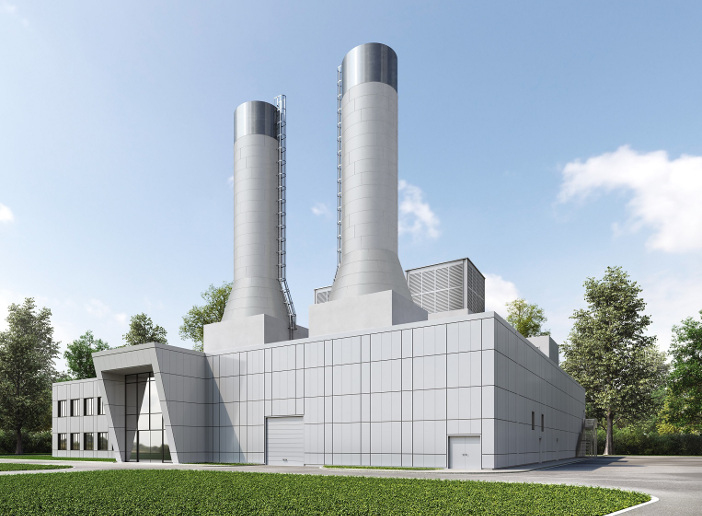
The testing facility in Ottobrun, Germany, is 4,500m2 in size and will be able to test electrical systems, batteries, power distribution, electricity generation and gas turbines.
Aritist’s Impression of the E-Aircraft Systems Test House (Image: Airbus)
Construction workers and Airbus employees celebrate the topping out of the new E-Aircraft Systems Test House (Image: Airbus)
“It’s future-proofed in terms of capability – first testing hybrid electric architecture and then fully-electric architecture.
“The building has a lot of hard points for the installation of the heavy equipment needed to test up to 20MW and we have a special thermal and ventilation system that’s built in to manage the specific heat losses that come from hybrid-electric propulsion. We’ve also got electromagnetic screening – it’s a facility that allows us to easily test up to 3,000V and even beyond,” Llewellyn says.
The Grid
Following a similar pathway, Collins Aerospace, which is now part of the USA’s United Technologies Corporation has invested US$50million into building a high-power, high voltage laboratory to design and test more electric aircraft (MEA) systems called The Grid. Currently being built in Rockford, Illinois, USA, The Grid is expected to be fully operational in two years’ time and will be 25,000ft2 in size.
Collins Aerospace’s the Grid laboratory will be dedicated to testing electrical systems
“The Grid is our response to the development of aircraft like the MEA Boeing 787,” says Todd Eckstaine, Collins Aerospace’s director of business development for electric power systems. “We see the industry heading towards more-electric, hybrid-electric propulsion and all-electric propulsion.
“The Grid is going to be a highly flexible platform where we’ll be able to test multiple different electric power ratings and voltage levels.”
Collins’s current largest laboratory has 3,000 horsepower of drive stand capability and can handle systems of up to 540V. The Grid is being designed to have around 8,000 horsepower drive stand capability and run up to the order of 3,000V.
“It’s a two-times step up from the integration labs we’ve had to date. We’re putting in the square footage and the cooling capabilities to future-proof the lab,” says Todd Spierling, chief engineer for advanced technology, United Technologies Advanced Projects (UTAP). “We’re trying to build a lab to serve the industry for the next 20, 30 years, not just the next two or three.”
“We’re not just going to test electrical propulsion systems, we will be testing all of the systems that need to be integrated.
“The lab is being configured to run as one and as separate units that can interconnect. We’ll be able to have half a dozen independent activities going on if that’s the most appropriate use at a given time and connect them together when necessary.”
One of the first projects to take place at The Grid will be work on the UTAP hybrid-electric flight demonstrator, Project 804, which will be based on a Bombardier Dash 8-100. The goal of this project is to re-engine and fly a regional turboprop aircraft powered by a 2MW-class hybrid-electric propulsion system. The Grid will be used to design and test a 1MW motor, a motor controller and battery system which will be used to assist the demonstrator’s fuel-burning engine as part of its hybrid-electric propulsion system.
E-Fan X
Back in Germany, one of the first testing projects at Airbus’s E-Aircraft Systems Test House this year will be for the E-Fan X hybrid-electric flight demonstrator. This project is integrating a 2MW hybrid-electric propulsion system onto a BAE 146 aircraft. The program, which also involves Rolls-Royce and Siemens, was launched in 2017 and aims to demonstrate technology for hybrid-electric single aisle airliners. Its first flight is targeted for 2021.
The E-Fan X demonstrator is planned to make its maiden flight in 2021
Llewellyn says, “Its architecture is made up of several major components including the 2MW electric motor which will be installed under the wing, replacing the gas turbine that powers the fan.
“The motor will be connected to an electric power distribution system and controller. This will manage the power coming from the generator – a gas turbine attached to an electric generator and the battery. The components of this 3,000V, 2MW system will all be tested at our facility.”
Ground testing of systems will start with normal operation and then move onto failure modes.
Electric aviation propulsion firm MagniX is involved in several MEA projects. Its magni250 and magni500 high power-to-weight brushless electric motors are powering Israel-based Eviation’s all-electric aircraft Alice, which is designed to take nine passengers up to 650 miles. The motors are also being used in an electric retrofit of operator Harbour Air’s fleet of de Havilland Canada DHC-2 Beavers.
Harbour Air is based in Vancouver, Canada and its flights average between 40-62 miles and last between 15 to 25 minutes. The CEO of MagniX, Roei Ganzarski, says that a lot of smaller operators would prefer to convert existing aircraft, rather than invest millions into buying new aircraft that can travel further than they need.
“In 2018, 5% of all global flights, 1.8 million trips, were of less than 100 miles, not including cargo and private aviation. All of the aircraft used for these flights are perfectly suited to conversion.
It will be faster and cheaper for the operators working these short routes to convert, plus they can continue to use aircraft they already know. Converting costs 20% of the cost of buying new,” he says.
The magni250 is a 280kW motor that produces 375 horsepower, while the magni500 is a 560kW motor that produces 750 horsepower – both turn at 1,900rpm; the same speed as the propeller. This has allowed MagniX to completely eliminate the need for a gearbox.
“Traditional internal combustion engines turn at much higher speeds to create that power. Because the electric motor turning at 1900rpm creates the same power, you can go directly to the propeller and eliminate the whole gearbox,” says Ganzarski.
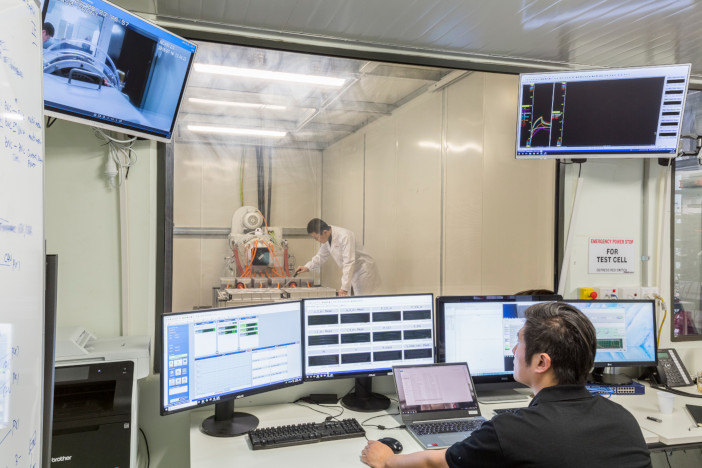
Both motors are currently in assembly and completing ground testing. The first set of tests are taking place in an enclosed test cell, turning against a dynamometer. “That allows you to test in a safe, enclosed fashion. There’s no turning, no propeller and a lot of sensors – temperature, vibration, noise, power. We can ensure the motor performs the way we’ve designed it to,” Ganzarski says.
The MagniX motor is being rigorously tested in enclosed cells
This month MagniX expects to start testing using its iron bird. The iron bird has been developed from the front end of an aircraft, which has had most of its equipment removed and replaced with the electric motor attached directly to the propeller.
Ganzarski says, “The iron bird testing allows us to go beyond testing the motor. We can test the whole system: the motor, cooling, propeller, governor. This is great because it allows for realistic testing right before flight.
“Then, in August we’ll move from the iron bird to integrating the system into the seaplanes and Alice. From there we’ll start ground testing the planes, start low-speed and then high-speed taxiing, before takeoff and then in-flight testing.”
The first test flight is expected to take place this November with certification of the motors expected by the end of 2021 and entry into service by 2022.
The certification requirements are yet
to be made clear, but Ganzarski expects his propulsion systems to be held to the same stringent reliability, consistency and safety levels that the global regulatory authorities expect from today’s non-electric systems.“We expect nothing to be easier because we’re trying something new – on the contrary we expect to have to prove the electric aspect thoroughly, that the batteries are safe and our aircraft are as reliable and safe as traditional craft today, he says.
Regulation versus innovation
Ganzarski doesn’t believe it is possible for regulation to keep up with innovation, nor should they attempt to. “It’s easy for industry to downplay and criticise regulatory bodies for not being flexible, or fast enough, but they have a very hard job, they have to ensure that things are safe.
“However, I do expect that they learn what’s going on ahead of time, so when the time comes to certify they’re ready to go. We’re working with the FAA and they’re very much leaning forward, trying to learn about electronic propulsion.
“Regulators learned a tough lesson with drones. They didn’t know what regulations were needed and there was chaos. But we’ve been in conversation with several regulatory bodies for some time and they’ve been learning, testing, evaluating. They’ve already begun to put together the precursors of what the future regulations will be.”
Researchers at Imperial College London in the UK have used supercomputers running simulations on graphics processors originally developed for video gaming to solve a longstanding question in turbulence.
Their results, published this week in the Journal of Fluid Mechanics, means empirical models can be tested and new models can be created, leading to more optimal designs in aerospace.
Current models of turbulence often rely upon empirical relationships based on previous observations of turbulence to predict what will happen, rather than a full understanding of the underlying physics, which are highly complex.
Co-author of the study, Identifying eigenmodes of averaged small-amplitude perturbations to turbulent channel flow’, Peter Vincent, from the Department of Aeronautics at Imperial College Lond, said, “We now have a solution for an important fundamental flow problem. This means we can check empirical models of turbulence against the correct answer, to see how well they are describing what actually happens, or if they need adjusting.”
The researchers started from the problem of working out how a disturbance in a turbulent fluid flowing through a channel dissipates. For example, if water was suddenly released from a dam into a river and then shut off, what affect would that pulse of dam water have on the flow of the river?
To determine the overall average behaviour of the fluid response, the team needed to simulate the myriad smaller responses within the fluid. They used supercomputers to run thousands of turbulent flow simulations, each requiring billions of calculations to complete.
Using these simulations, they were able to determine the exact parameters that describe how the disturbance dissipates in the flow and determined various requirements that empirical turbulence models must satisfy.
Co-author of the study, Professor Sergei Chernyshenko, from the Department of Aeronautics at Imperial, said, “From my first days studying fluid mechanics I had some fundamental questions that I wanted to know the answers to. This was one of them, and now after 40 years I have the answer.”
What’s that hole in the tail? A giant screw hole for towing the aircraft? An air conditioning intake? It’s part of what’s called an auxiliary power unit. An airliner’s APU is a hidden extra engine, typically a gas turbine engine like jet engines themselves. But the APU doesn’t help the plane move. Rather, when an airplane is parked at the gate, pilots will use the APU to power onboard electric systems—from cabin lights and coffee makers to various cockpit systems—as well as to provide airflow to the air conditioning systems. Additionally, the APU is typically used to start the engines as the plane is pushed back from the gate. Once the engines are running, the APU is normally switched off, to be restarted only when the plane is on the ground at its destination.
When it comes to cooling and lighting a parked plane, the APU is much more efficient than the main engines. But it still uses fuel—indeed, the APU on a very large airliner may be as powerful as the main engines installed on a smaller aircraft—so it makes sense to use it as little as possible.
At many airports, to reduce APU usage, a parked plane can use external power—essentially, the jet can be plugged into the airport’s own power supply. It’s easy to see the cables from the windows of the terminal—they generally attach to the plane somewhere near the nose wheel. When a parked plane receives electrical power from external sources this way, there’s no need for the APU to be running. Similarly, a plane can also receive external air conditioning. You might see one or more inflated tubes, often yellow, snaking into the belly of the jet (the external air conditioning units themselves may be located under the jet bridge).
Those external sources of electricity and air need to be disconnected before the plane pushes back from the gate. From the cabin, just before departure, you may hear the APU starting, followed by an unmistakable whoosh of airflow as it takes over the air conditioning of the aircraft. On some aircraft you may also see the lights in the cabin briefly flicker. That’s the moment the pilots have switched the aircraft from the airport-based electricity supply to the aircraft-based APU. The ground staff can then detach the cables and air hoses from the aircraft’s belly. And then your jet is ready to roll.
Once you park at your destination, the sooner the ground electricity is plugged in, the sooner the APU can be turned off, and the more fuel is saved. But if external power for an aircraft isn’t available at a certain gate or airport, then the APU will be left running for the entire time the plane is parked. If the plane isn’t due to fly again for some time, it may be depowered completely.
The APU has another role in saving fuel. Many planes will taxi out to the runway before takeoff or to the gate after landing with an engine shut down. On a twin-engine jet the APU may be left running or started up for such occasions to provide a backup source of power. On many aircraft, especially twin-engine airliners, the APU can also provide backup power in flight.
If the APU starts the main engines, then what starts the APU? Typically an aircraft’s batteries. There’s often a whoosh of airflow from the APU just before departure, but then everything seems to go nearly silent again just after your flight starts to push back. You may think the APU has been shut down, but the APU is likely still running. Its airflow is being diverted from the air conditioning systems to help start the main engines. As the main engines are powered up, they take over the air conditioning and everything else, and the APU is typically shut down.
SpaceX’s prototype rocket for a planned Starship vehicle has flown untethered for the first time.
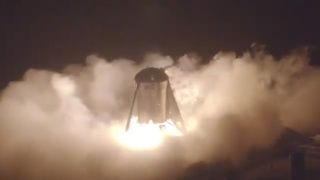
Called Starhopper, the rocket made its first free-flying test hop at SpaceX’s Boca Chica proving ground in South Texas late Thursday (July 25), one day after a glitch forced it to abort an earlier attempt. Starhopper ignited its single Raptor engine just before midnight, apparently firing long enough to meet the test’s main objective, which SpaceX founder and CEO Elon Musk had said would be a straight hop 65 feet (20 meters) up and down.
“Starhopper test flight successful,” Musk wrote on Twitter after the test. “Water towers *can* fly haha!!” (Starhopper is a large, squat cylinder on three legs wrapped in stainless steel, giving it a “water tower” look.)
Musk also released stunning close-up video of the test hop and the Raptor engine on Twitter early Friday.
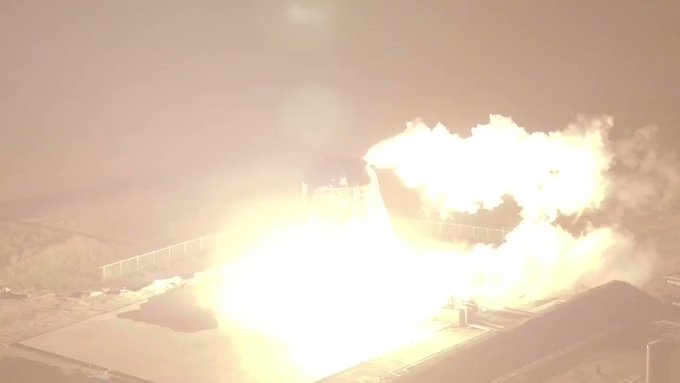
SpaceX’s Starhopper Starship prototype makes its first untethered flight at the company’s Boca Chica test site in South Texas on July 29, 2019 in this still from a drone camera.
(Image credit: Elon Musk/SpaceX via Twitter)
Starhopper is a testbed vehicle designed to test out vital technologies for SpaceX’s planned Starship and Super Heavy spacecraft, a planned fully reusable launch system capable of launching more payload than NASA’s mighty Saturn V moon rocket. Starship is designed to carry up to 100 people at a time, and will be SpaceX’s go-to spacecraft for eventual trips to the moon and Mars, Musk has said. It could even be used for point-to-point travel around Earth, he’s added.
During Thursday night’s test, Starhopper briefly lit up its Boca Chica proving ground, only to be quickly obscured by its exhaust plume as it rose up and landed within a minute. A video of the hop was streamed live on the Everyday Astronaut YouTube channel. Flames from the test hop ignited a fire near Starhopper that continued to burn well after the test itself, according to the video.
The test hop Thursday night followed an aborted attempt on Wednesday (July 24) when Starhopper fired its liquid methane/liquid oxygen fueled Raptor engine for just 3 seconds before shutting down.
Musk has said that the abort was caused by high chamber pressure on Starhopper, apparently due to “colder than expected propellant.” An even earlier untethered hop attempt last week ended not with a liftoff, but with a brilliant fireball that did not cause lasting damage to Starhopper, Musk said.
“Yeah, big advantage of being made of high strength stainless steel: not bothered by a little heat!” he wrote on Twitter.
Starhopper made two tethered test hops in early April. SpaceX has also test-fired the rocket’s main Raptor engine on the ground successfully.
Shortly after Thursday night’s test hop, Musk said Starhopper will aim even higher in an upcoming test.
“200 [meter] hop in a week or two,” Musk wrote on Twitter.
Musk has also said in recent days that he will give an update on the Starship launch system’s design. In a series of tweets, he pledged to give an update on the Starship program after Starhopper’s first untethered hop.
Thursday’s untethered hop came about six hours after SpaceX launched its 18th robotic cargo mission to the International Space Station for NASA. A Falcon 9 rocket lofted a twice-flown Dragon capsule toward the orbiting lab, marking the first time that a Dragon has launched three times.
The Falcon 9’s first stage was used as well, with one flight already under its belt.
Editor’s note: SpaceX’s Starhopper test hop on July 25, 2019 begins at the 1-hour, 15-minute mark of the Everyday Astronaut video above.
Pristine samples of the Red Planet will come down to Earth a little over a decade from now, if everything goes according to plan.
NASA and the European Space Agency (ESA) are working together on a highly anticipated Mars sample-return mission, which advocates say is the logical next step in our study of the Red Planet and its life-hosting potential.
“We need to bring [Martian] materials back and bring them into our laboratories,” Brian Muirhead, of NASA’s Jet Propulsion Laboratory in Pasadena, California, said during a presentation with NASA’s Future In-Space Operations (FISO) working group last month.
Related: The Search for Life on Mars (A Photo Timeline)
Scientists in labs around the world will be able to analyze such samples much more precisely, and in many more ways, than a rover could do by itself on the Red Planet, helping us “to understand the history of Mars from a biological point of view,” added Muirhead, who leads NASA’s Mars sample-return campaign.
Researchers could even find signs of life in these Mars rocks, which are scheduled to return to Earth in 2031.
The NASA-ESA plan is not yet official, Muirhead stressed, and details are still being worked out. But here’s a rundown of the concept, as it’s currently conceived.
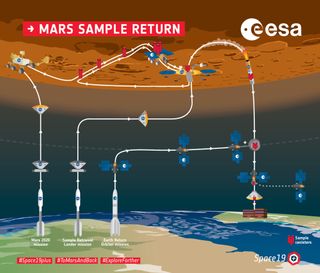
The campaign begins next July, with the launch of NASA’s car-size Mars 2020 rover. The six-wheeled robot is scheduled to touch down in February 2021 inside the 30-mile-wide (50 kilometers) Jezero Crater, which hosted a river delta in the ancient past.
Mars 2020 (which will soon get a catchier moniker, via a student naming competition) will characterize Jezero’s geology, hunt for signs of ancient life, demonstrate various technologies that could enable future human exploration of the Red Planet and perform a variety of other work, including the collection and caching of samples.
The rover carries 43 tubes for this purpose, five of which will be “references” that help researchers understand the environment the other tubes have been through, Muirhead said. So Mars 2020 could snag a maximum of 38 samples. Ideally, the rover will drop some of these in an accessible spot and keep others on its body, he added.
The next big step comes in 2026, with the launch of NASA’s Sample Retrieval Lander (SRL) mission. SRL will include a stationary lander, the ESA-provided Sample Fetch Rover (SFR) and a rocket called the Mars Ascent Vehicle (MAV), which will be no more than 10 feet (3 meters) tall, Muirhead said.
The mission will touch down near the Mars 2020 landing site, and then SFR will hit the red dirt. This little robot will be smaller than NASA’s golf-cart-size Spirit and Opportunity rovers, and it will leverage technology developed for ESA’s life-hunting ExoMars rover, which is scheduled to launch toward the Red Planet next summer, just a week after Mars 2020 does.
The SFR will carry no science instruments, Muirhead said. Its lone job, as its name indicates, will be to get the samples dropped by Mars 2020 back to the lander, where they will be placed into the basketball-size Orbiting Sample container, or OS. (The sample-return campaign is complex, so it’s even heavier on the acronyms than most space missions are.) If Mars 2020 does indeed hold on to some of its collected samples, this bigger rover could roll over to the lander as well.
“We’ve had to design the lander to accommodate both of these rovers coming and delivering tubes to us,” Muirhead said.
Related:The Boldest Mars Missions in History
Launching off the Martian surface
An overview of the planned NASA-ESA Mars sample-return campaign.
(Image credit: K. Oldenburg/ESA)
All of this will take time. The SRL surface mission is expected to last about eight months, with five months devoted to fetching, Muirhead said. Meanwhile, the MAV will be sitting there, waiting for its moment.
“It’s got to survive the surface environment — mostly [low] temperature, but dust also,” Muirhead said. “And then it’s got to launch and deliver into Mars orbit. So, it’s a challenging environment for rocket propulsion.”
Spacecraft have launched from the surface of Earth’s moon before — the Apollo missions did this multiple times — but no vehicle has ever left the much more massive Mars after landing there. So the MAV will make exploration history.
The MAV’s specs have yet to be firmed up, Muirhead said. The sample-return team is looking at two options: a two-stage solid-propellant version, and a single-stage rocket that employs hybrid propulsion technology. A decision on the design should come by the end of the year, Muirhead said.
After taking the OS on board, the MAV will launch off the solar-powered lander and deploy the OS container into Mars orbit, at least 190 miles (300 km) above the planet’s surface. It will be plucked out of the void by the third big piece of this grand plan: ESA’s Earth Return Orbiter (ERO).
Bringing it all back home
How to Get Mars Samples to Earth – 3 Missions Necessary?
Like the SRL mission, ERO is scheduled to launch in 2026. ESA recently invited European companies to submit proposals to build the spacecraft.
“The mission is becoming a reality, and we are proud to give European industry the chance to join the challenge,” ESA’s Orson Sutherland, study manager for ERO, said in a statement.
The ERO will use electric propulsion and feature multistage detachable modules, leveraging technologies developed for the recently launched BepiColombo mission to Mercury, ESA officials said.
The European orbiter will install the newly captured OS inside a sterile containment system and then sterilize the joints of that system, likely using heat, Muirhead said. Such protocols will ensure that no Mars material leaks out during entry to Earth’s atmosphere, potentially contaminating our planet.
The containment system will be placed inside a special entry vehicle, which will deploy from the ERO when the spacecraft nears Earth. The entry vehicle will barrel through our planet’s atmosphere and slam into a playa, or dry lake bed, in Utah.
The team has designed the entry vehicle to operate without parachutes, relying instead on completely passive technologies. This strategy takes one big potential failure point out of play, Muirhead said.
The entry vehicle will experience impact forces of about 1,000 Gs if it hits the playa dirt, and perhaps 3,000 Gs if it’s unlucky enough to slam into a rock, Muirhead said. (The acceleration at Earth’s surface due to our planet’s gravity is 1 G.)
“We’re designing to both of those [scenarios],” he added.
The targeted landing date is 2031. Mars and Earth align favorably for interplanetary launches just once every 26 months. So, if the SRL and ERO aren’t ready in 2026, the next opportunity would come in 2028, with a 2033 sample return to Earth.
“But beyond that, we really lose opportunities to do MSR [Mars sample return],” Muirhead said. “This is really a good opportunity, and we’re working very hard to make this opportunity pay off.”
Again, the campaign outlined above is just a concept at the moment. Though the 2020 federal budget request allocates some money to NASA for MSR development, the project is not officially on NASA’s books yet, or those of ESA.
So we don’t know how much all of this would cost. Muirhead said the team is treating the campaign as cost-constrained with a hard cap, though it’s unclear what that cap will be.
MSR will be tough to pull off, requiring “multiple missions that will be more challenging and more advanced than any robotic missions before,” ESA officials said in a different statement.
But the team thinks it’s up to the challenge.
“The campaign and the design studies that we’ve been conducting with ESA are proceeding extremely well,” Muirhead said. “We are prepared to proceed with this partnership to implement the objectives, pending approval from our respective funding agencies.”
NASA’s most recent planet-hunting satellite, known as the Transiting Exoplanet Survey Satellite, or TESS, has just discovered a type of new planet – one that’s missing from our solar system.
Launched in 2018, led and run by the Massachusetts Institute of Technology (MIT), and managed by NASA’s Goddard Space Flight Center, TESS has been on the lookout for these exact types of discoveries.
Now its succeeded in part of its mission, by finding three new planets that are based around a neighboring star. The findings of the mission have been published in the journal Nature Astronomy.
TOI-270 exactly what the satellite was looking for
University of California associate professor of planetary astrophysics, Stephen Kane, who is assisting NASA’s exoplanetary mission, said that the TOI-270 – or the TESS Object of Interest – is precisely what the satellite has been searching for.
TESS Object of Interest – is precisely what the satellite has been searching for.
Exoplanets, like the ones found here, are planets that lie outside of our solar system.
TESS discovered two that are gaseous and approximately twice the size of the planet we call home, whereas the third, smaller, planet is rocky and just slightly bigger than Earth.
The smaller planet is in fact in the habitable zone, meaning it’s at a distance from a star that is warm enough to heat its water to a liquid state. Moreover, its deemed as our ‘neighbor’ as it’s close enough to be seen brightly.
NASA_TESS
✔@NASA_TESS
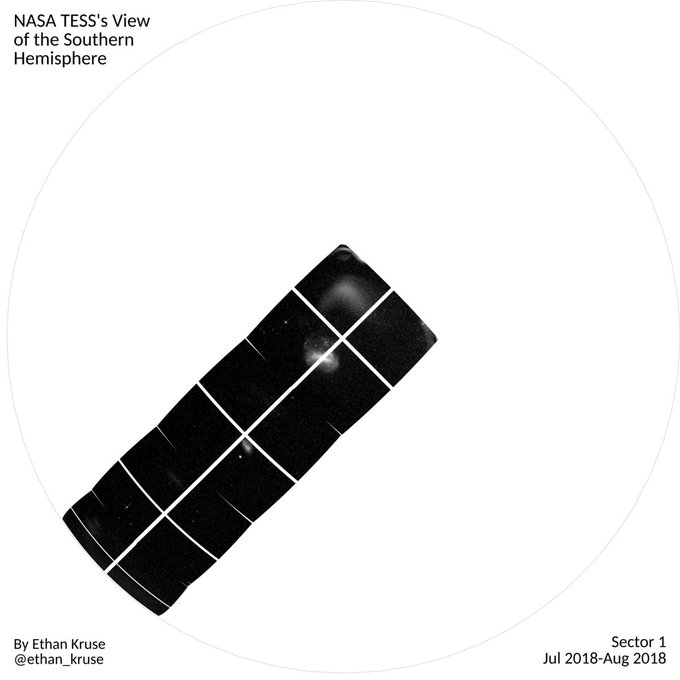
.@NASA_TESS just completed the first year of its mission, in which it surveyed the southern sky. This week, scientists are gathering @MIT to share new and exciting results made from studying this first year of data collected by TESS! #TESSCon
It’s also supposedly in a ‘quiet’ spot, with few flares, allowing scientists and astrophysicists to view it more clearly than others.
‘Habitable zone’
Kane said, “We’ve found very few planets like this in the habitable zone, and many fewer around a quiet star, so this is rare.”
This infographic illustrates key features of the TOI 270 system, located about 73 light-years away in the southern constellation Pictor. The three known planets were discovered by NASA’s Transiting Exoplanet Survey Satellite through periodic dips in starlight caused by each orbiting world. Insets show information about the planets, including their relative sizes, and how they compare to Earth. Temperatures given for TOI 270’s planets are equilibrium temperatures, calculated without the warming effects of any possible atmospheres. Source: Scott Wiessinger/NASA’s Goddard Space Flight Center
“We don’t have a planet quite like this in our solar system,” he continued.
It doesn’t end there, though. The team plans on following up its observations next year when the James Webb Space Telescope launches.
Compare and contrast worlds in the TOI 270 system with these illustrations of each planet. Temperatures given for TOI 270 planets are equilibrium temperatures, calculated without taking into account the warming effects of any possible atmospheres. Source: NASA’s Goddard Space Flight Center
The research team is looking to see if the planet could be habitable by measuring its composition for oxygen, hydrogen, and carbon monoxide.
The waxing and waning of sunspots forms part of our Sun’s natural cycle, but it’s a phenomenon astronomers still don’t fully understand. Now, new research has revealed that particular “terminator” events are what brings sunspot cycles to an end, and it means we could get better at predicting them.
That would be rather useful, too. If we can predict sunspot cycles on that huge ball of hot plasma with greater accuracy, this will mean more advanced warning of the types of solar storms that can disrupt electronics and infrastructure on Earth.
The findings are based on almost 140 years of solar observations, and include careful recordings of coronal bright points (brief flickers of extreme ultraviolet light) that happen during periods of relative calm on the Sun.
The movement and eventual disappearance of these points is what marks a terminator event, the researchers say.
“The evidence for terminators has been hidden in the observational record for more than a century, but until now, we didn’t know what we were looking for,” says astrophysicist Scott McIntosh, from the National Center for Atmospheric Research (NCAR) in the US.
“By combining such a wide variety of observations over so many years, we were able to piece together these events and provide an entirely new look at how the Sun’s interior drives the solar cycle.”
We already know that a sunspot cycle lasts around 11 years (we’re right at the end of one now). After a solar minimum, or a period of quiet on the face of the Sun, the number of sunspots gradually increases again; they form at a latitude of 35 degrees in both hemispheres, before making their way to the equator and eventually dying out.
Solar minimum (left) and solar maximum (right). (NASA)
This whole process typically takes a little over a decade, with the midpoint known as the solar maximum – when the sunspot activity is most intense. (April 2014 marked the peak of the most recent solar maximum.)
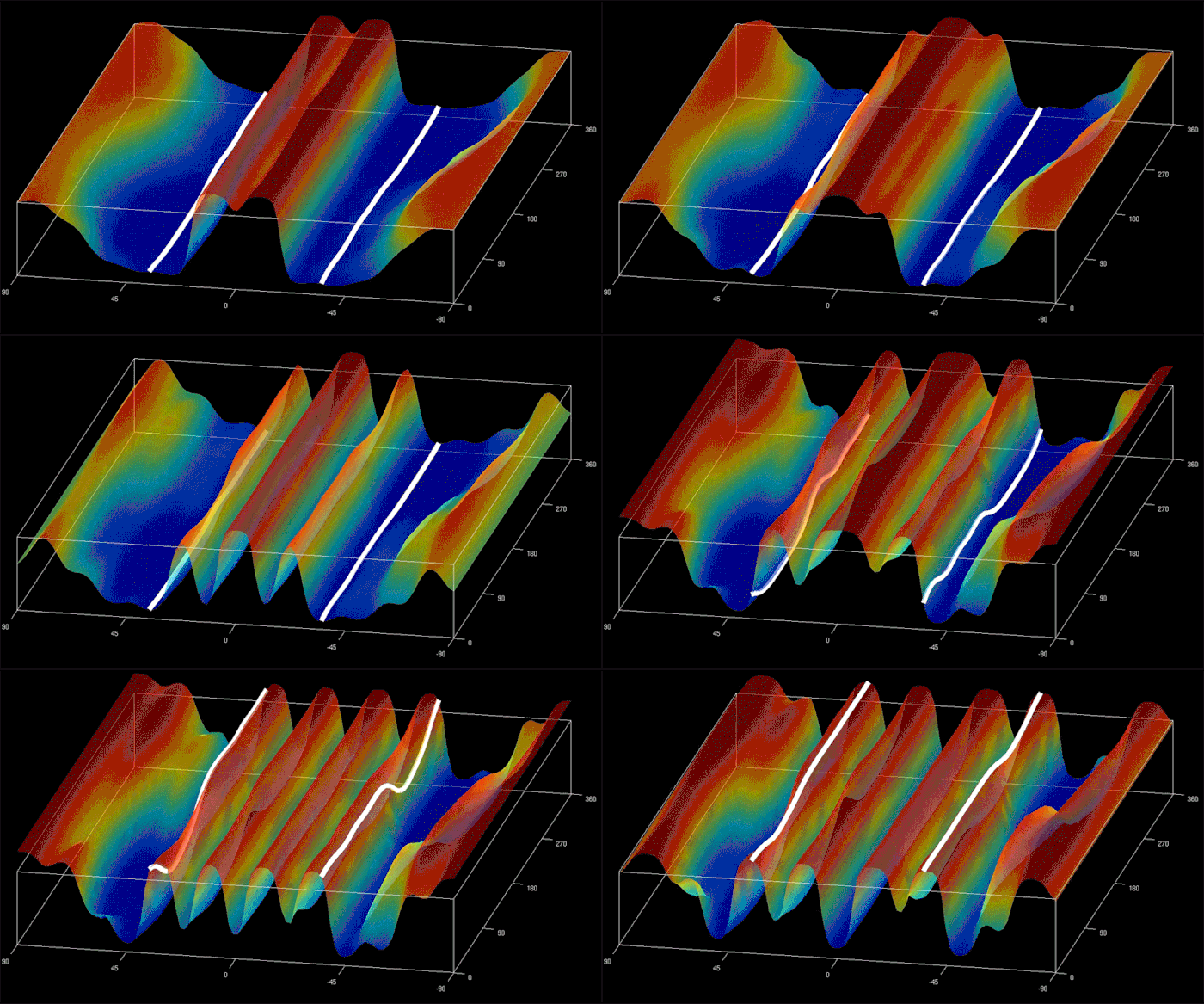
The coronal bright points also travel from higher latitudes towards the equator, though the journey takes longer. At certain points they overlap with sunspots, and the researchers think these bright points are markers of toroidal magnetic field movement. These fields wrap around the Sun like rubber bands, and also migrate towards the equator.
When the magnetic fields rise to the surface of the Sun, sunspots emerge to join the coronal bright points, the scientists propose. As the spots move, they build up plasma behind them. When one wave of a toroidal magnetic field hits another one travelling in the opposite direction on the equator, that plasma is released. The release is quite dramatic – the research suggests a “solar tsunami” of plasma is let loose, travelling back away from the equator at around 300 metres (or 984 feet) per second. That wave soon meets another toroidal magnetic field coming the other way, causing it to bob up and form sunspots, and the cycle begins again. This is still a hypothesis for now, but it’s based on a lot of accumulated data and some very educated guesswork. With the current solar cycle due to end and start up again within the next year, the scientists will be watching to see if their models and predictions are correct.
As well as promising to teach us more about this fundamental process happening on our host star, the research is a testament to the way multiple observations and multiple data streams can unlock scientific discoveries that would otherwise prove more difficult to uncover.“We were able to identify these terminators by looking at data from a whole range of different measures of solar activity – magnetic fields, spectral irradiance, radio flux – in addition to the bright points,” says astronomer Bob Leamon, from the University of Maryland.
“The results demonstrate that you really need to be able to step back and use all the available data to appreciate how things work – not just one spacecraft or one observation or one model.”
The VASIMR (Variable Specific Impulse Magnetoplasma Rocket) concept originated in 1977 with former NASA astronaut Franklin Chang Díaz, who has been developing the technology ever since.
An electric power source ionizes hydrogen, deuterium, or helium fuel into a plasma by stripping away electrons. Magnetic fields then direct the charged gas in the proper direction to provide thrust.
“A rocket engine is a canister holding high-pressure gas,” Chang Diaz explained. “When you open a hole at one end, the gas squirts out and the rocket goes the other way. The hotter the stuff in the canister, the higher the speed it escapes and the faster the rocket goes. But if it’s too hot, it melts the canister.”
The VASIMR engine is different, Chang Diaz explained, because of the fuel’s electrical charge: “When gas gets above 10,000 [kelvins], it changes to plasma – an electrically charged soup of particles. And these particles can be held together by a magnetic field. The magnetic field becomes the canister, and there is no limit to how hot you can make the plasma.”
Every part of a VASIMR engine is magnetically shielded and does not directly contact plasma, increasing durability. Additionally, the lack of electrodes eliminates the electrode erosion that shortens the life of conventional ion thruster designs.
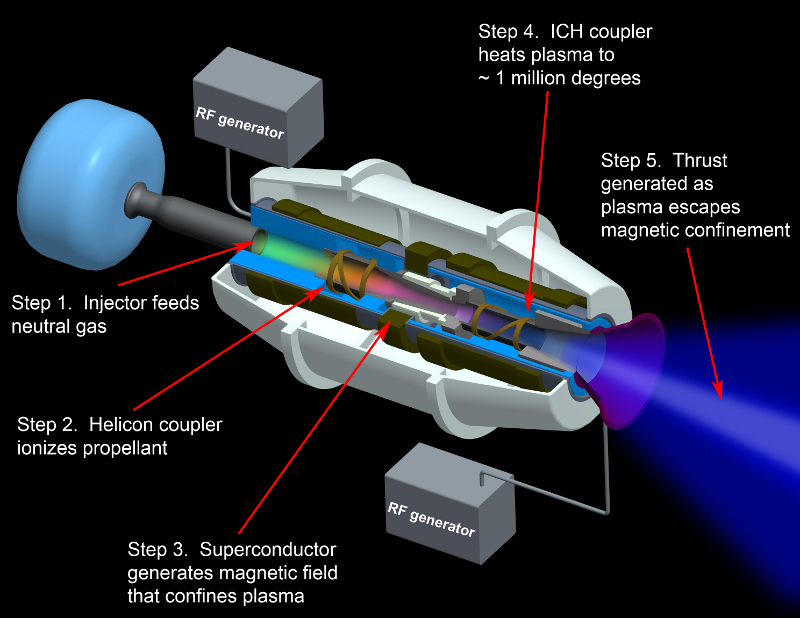
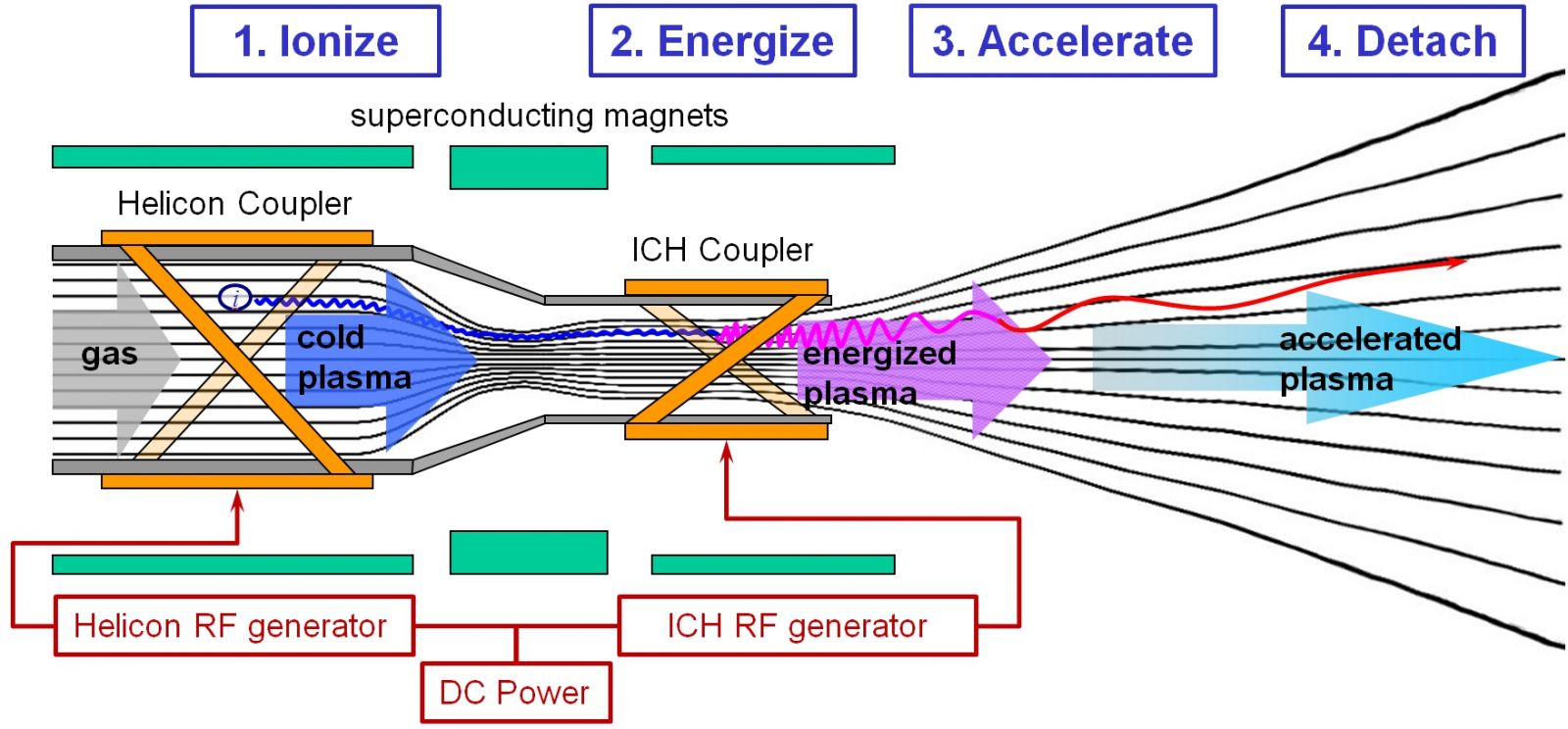
The propellant, a neutral gas such as argon or xenon, is injected into a hollow cylinder surfaced with electromagnets. On entering the engine, the gas is first heated to a “cold plasma” by a helicon RF antenna/coupler that bombards the gas with electromagnetic energy, stripping electrons off the propellant atoms and producing a plasma of ions and free electrons. By varying the amount of RF heating energy and plasma, VASIMR is claimed to be capable of generating either low-thrust, high–specific impulse exhaust or relatively high-thrust, low–specific impulse exhaust. The second phase of the engine is a strong electromagnet positioned to compress the ionized plasma in a similar fashion to a convergent-divergent nozzle that compresses gas in traditional rocket engines.
A second coupler, known as the Ion Cyclotron Heating (ICH) section, emits electromagnetic waves in resonance with the orbits of ions and electrons as they travel through the engine. Resonance is achieved through a reduction of the magnetic field in this portion of the engine that slows the orbital motion of the plasma particles. This section further heats the plasma to greater than 1,000,000 K (1,000,000 °C; 1,800,000 °F) —about 173 times the temperature of the Sun‘s surface.
The path of ions and electrons through the engine approximates lines parallel to the engine walls; however, the particles actually orbit those lines while traveling linearly through the engine. The final, diverging, section of the engine contains an expanding magnetic field that ejects the ions and electrons from the engine at velocities as great as 50,000 m/s (110,000 mph).
Advantages
In contrast to the typical cyclotron resonance heating processes, VASIMR ions are immediately ejected from the magnetic nozzle before they achieve thermalized distribution. Based on novel theoretical work in 2004 by Alexey V. Arefiev and Boris N. Breizman of University of Texas at Austin, virtually all of the energy in the ion cyclotron wave is uniformly transferred to ionized plasma in a single-pass cyclotron absorption process. This allows for ions to leave the magnetic nozzle with a very narrow energy distribution, and for significantly simplified and compact magnet arrangement in the engine.
VASIMR does not use electrodes; instead, it magnetically shields plasma from most hardware parts, thus eliminating electrode erosion, a major source of wear in ion engines. Compared to traditional rocket engines with very complex plumbing, high performance valves, actuators and turbopumps, VASIMR has almost no moving parts (apart from minor ones, like gas valves), maximizing long term durability.
Disadvantages
According to Ad Astra as of 2015, the VX-200 engine requires 200 kW electrical power to produce 5 N of thrust, or 40 kW/N. In contrast, the conventional NEXT ion thruster produces 0.327 N with only 7.7 kW, or 24 kW/N. Electrically speaking, NEXT is almost twice as efficient, and successfully completed a 48,000 hours (5.5 years) test in December 2009.
New problems also emerge with VASIMR, such as interaction with strong magnetic fields and thermal management. The inefficiency with which VASIMR operates generates substantial waste heat that needs to be channeled away without creating thermal overload and thermal stress. The superconducting electromagnets necessary to contain hot plasma generate tesla-range magnetic fields that can cause problems with other onboard devices and produce unwanted torque by interaction with the magnetosphere. To counter this latter effect, two thruster units can be packaged with magnetic fields oriented in opposite directions, making a net zero-torque magnetic quadrupole.
The required power generation technology for fast interplanetary travel does not currently exist and is not feasible with current state-of-the-art technology.
Chang Diaz has pointed out that hydrogen would be an advantageous fuel for the VASIMR engine because the spacecraft would not have to lift off carrying all the fuel it needs for the journey.
“We’re likely to find hydrogen pretty much anywhere we go in the Solar System,” he said.
A spacecraft using conventional chemical rockets would take eight months to get to Mars during opposition. However, the VASIMR engine would make the journey in as little as 39 days.
Chang Diaz explained: “Remember, you are accelerating the first half of the journey – the other half you’re slowing, so you will reach Mars but not pass it. The top speed with respect to the Sun would be about 32 miles per second [or 51.5 km/s]. But that requires a nuclear power source to heat the plasma to the proper temperature.”
The use of nuclear power in space is not without its controversy. In 1997, there was widespread public concern when NASA’s Cassini probe, which carried a plutonium battery, made a flyby of Earth to perform a gravity assist. Although NASA denied that the risk to the public, should an accident occur, was no greater than that posed every day by other sources of radiation, some scientists, including the popular theoretical physicist Michio Kaku, disagreed.
In April 1970, the Atomic Energy Commission was deeply concerned about the return of Apollo 13 to Earth. Where an Apollo mission would usually leave the lunar module’s descent stage on the Moon, the unsuccessful Apollo 13 dropped its lunar module Aquarius, with its plutonium-powered scientific experiments, into the ocean, raising concerns about radioactive contamination.
Elon Musk, CEO of Space Exploration Technologies Corporation (SpaceX), is skeptical about the viability of the VASIMR engine. One reason is the concern about radioactive debris falling to Earth in the event of an accident.
Musk is also skeptical that the VASIMR engine would be a significant improvement over chemical rockets, stating: “So people like Franklin – basically it’s a very interesting ion engine he’s got there, but it requires a big nuclear reactor. The ion engine is going to help a little bit, but not a lot in the absence of a big nuclear reactor.” Musk also points out that the big nuclear reactor would add a lot of weight to a rocket.
Chang Diaz dismisses the concerns about nuclear reactors in space, stating: “People are afraid of nuclear power. Chernobyl, Three Mile Island, Fukushima – it is a little misunderstood. But if humans are truly going to explore space, we eventually will have to come to grips with the concept.”
Another vocal critic of the VASIMR engine is Robert Zubrin, president of The Mars Society, who designed the Mars Direct plan to colonize Mars and wrote the popular book The Case For Mars. He has gone as far as to call the VASIMR engine a “hoax”. Zubrin wrote in SpaceNews: “To achieve his much-repeated claim that VASIMR could enable a 39-day one-way transit to Mars, Chang Diaz posits a nuclear reactor system with a power of 200,000 kilowatts and a power-to-mass ratio of 1,000 watts per kilogram. In fact, the largest space nuclear reactor ever built, the Soviet[-era] Topaz, had a power of 10 kilowatts and a power-to-mass ratio of 10 watts per kilogram. There is thus no basis whatsoever for believing in the feasibility of Chang Diaz’s fantasy power system.”
Chang Diaz, however, says in his paper: “Assuming advanced technologies that reduce the total specific mass to less than 2 kg/kW, trip times of less than 60 days will be possible with 200 MW of electrical power. One-way trips to Mars lasting less than 39 days are even conceivable using 200 MW of power if technological advances allow the specific mass to be reduced to near or below 1 kg/kW.”
The 2011 NASA research paper “Multi-MW Closed Cycle MHD Nuclear Space Power Via Nonequilibrium He/Xe Working Plasma” by Ron J. Litchford and Nobuhiro Harada, indicates that such developments are feasible in the near future.
Whether the VASIMR engine is viable or not, in 2015, NASA awarded Chang Diaz’s firm – Ad Astra Rocket Company™ – a three-year, $9 million contract. Up to now, the VASIMR engine has fired at fifty kilowatts for one minute – still a long way from Chang Diaz’s goal of 200 megawatts.
In its current form, the VASIMR engine uses argon for fuel. The first stage of the rocket heats the argon to plasma and injects it into the booster. There, a radio frequency excites the ions in a process called ion cyclotron resonance heating. As they pick up energy, they are spun into a stream of superheated plasma and accelerated out the back of the rocket.
[smartslider3 slider=”2″]
Solar cells that transfer sunlight into electricity are a brilliant part of modern technology, but one particular aspect has proven to be a huge headache. They’re not super efficient – most of the sunlight they absorb is lost in the form of heat.
As a result, the average efficiency of a commercial solar panel is between 11 and 22 percent. Now, a new device could boost that to a whopping 80 percent.
The design is based on an array of single-wall carbon nanotubes, which recapture the thermal photons of infrared radiation – that’s the heat – lost by solar cells. Then, the device emits that energy as light in a different wavelength, which in turn can be recycled into electricity.
“Thermal photons are just photons emitted from a hot body,” explained engineer Junichiro Kono of Rice University. “If you look at something hot with an infrared camera, you see it glow. The camera is capturing these thermally excited photons.”
Infrared radiation is the part of sunlight that carries warmth. It’s invisible to the naked human eye, but is on the same electromagnetic spectrum as light and radio waves, and X-rays. It’s emitted by your stove, or a campfire, or even by your warm cat, purring on your lap. Basically, anything that emits heat is emitting infrared radiation.
“The problem,” said engineer Gururaj Naik, “is that thermal radiation is broadband, while the conversion of light to electricity is efficient only if the emission is in a narrow band. The challenge was to squeeze broadband photons into a narrow band.”
Their system involved fine films of densely packed carbon nanotubes, already developed by Kono and colleagues in 2016.
One of the properties of these nanotubes is that electrons in them can only travel in one direction. This produces an effect called hyperbolic dispersion, whereby the films are metallic conductors in one direction, but insulators perpendicular to that direction.
That means that the thermal photons can enter from pretty much anywhere… but they can only exit one way. This squeezing process converts the heat to light; from there, it can be converted into electricity.
In the proof-of-concept device the team developed, the carbon nanotube film can withstand temperatures up to 700 degrees Celsius (1,292 Fahrenheit), although the material is capable of withstanding a much higher heat, up to 1,600 degrees Celsius (1,292 Fahrenheit).
The engineering team then subjected their device to a heat source to confirm the narrow-band output. Each one of the resonator cavities in the film reduced the band of the thermal photons, producing light.