Artificial gravity is a concept that is ubiquitous in our science fiction yet elusive in our space program. Why is this? And how could we develop artificial gravity soon? In a Cool Worlds special, this video essay goes in depth on the topic discussing why centrifuges are the most plausible solution and early ideas on the topic. Join us a journey from Einstein’s equivalence principle, to O’Neill Cylinders and Stanford Tori; from Coriolis forces to near-term experiments. Grab a cup of a tea and enjoy.
► Harris et al. (2014), “How Much Gravity Is Needed to Establish the Perceptual Upright?”, PLoS One, 9, e106207: https://www.ncbi.nlm.nih.gov/pmc/arti… (0.15g)
► Cohen et al. (2000), “Effects of Prolonged Centrifugation on Orthostasis”, Aerospace Medical Association 72nd Annual Scientific Meeting 2001: https://ntrs.nasa.gov/search.jsp?R=20…
► Graybiel et al. (1960), “Observations on Human Subjects Living in a ‘Slow Rotation Room’ for Periods of Two Days”, Arch Neurol., 3, 55: https://jamanetwork.com/journals/jama…
► Theodore Hall (1993), “The Architecture of Artificial Gravity: Archetypes and Transformations of Terrestrial Design”, PhD Thesis, University of Michigan: http://www.artificial-gravity.com/SSI…
► Theodore Hall (2002), “Architectural Considerations for a Minimum Mass, Minimum Energy, Artificial Gravity Environment”, SAE Technical paper Series, http://www.artificial-gravity.com/SAE…
The electric vertical take off and landing prototype aircraft being developed by Munich-based Lilium has completed the first phase of flight testing.
The video shows for the first time the prototype air taxi taking off, rotating its wings to transition to horizontal flight then doing the same again to land. According to the Lilium the aircraft has also achieved speeds in excess of 100km/h during its first flight earlier this year.
Lilium, which plans to be operating commercial passenger operations by 2025, made the maiden flight of its prototype eVTOL (electric vertical take off and landing) aircraft in May earlier this year.
The Lilium Jet is a five-seater, all-electrical, vertical takeoff and landing jet that is designed to complete journeys of up to 300km in a hour on a single charge, enabling intercity travel.
The first manufacturing facility, a 3,000 square meter space located at the company’s headquarters, will soon be complemented by a second, much larger, facility which is already under construction at the same site. The company aims to be producing hundreds of aircraft a year by the time commercial services begin in 2025.
The Lilium Jet prototype is powered by 36 all-electric jet engines through ducted fans in the wins and is said to require less than 10% of its maximum 2000 horsepower during horizontal cruise flight
The aircraft, which is so far being controlled remotely from the ground during flights, will now move on to its second phase of testing which will look specifically at how it performs at high speeds.
Leandro Bigarella, head of flight test, said, “The Lilium Jet continues to meet our expectations, delivering excellent in-flight performance and remarkably smooth transition from vertical to horizontal flight.
“We take a relentless approach to improvement and, like any good testing program, we have had the chance to implement a number of refinements to the aircraft along the way.
“We are now moving into a critical stage of testing as we prepare for high-speed operations and eventual certification by the relevant authorities.”
The company’s new production facilities will be located at the company’s headquarters in Munich, Germany. Daniel Wiegand, co-founder and CEO of Lilium said, “Our ambition is to develop a world-class production facility here that will allow us to build critical parts ourselves and then deliver fully-assembled aircraft at the scale of the automotive sector but at the extremely high-quality levels required in the aerospace sector.
“Having our production facility co-locate with our headquarters also makes sense at this point in our development, allowing us to maintain the rapid pace at which we are developing the Lilium Jet, from innovation through to engineering and manufacturing.”
Lilium employs more than 350 people at its base in Munich, with more than 150 roles currently available across a range of disciplines. The new production facilities are expected to create up to 500 new jobs between now and 2025.
For every action, there is a reaction: that is the principle on which all space rockets operate, blasting propellant in one direction to travel in the other. But one NASA engineer believes he could take us to the stars without any propellant at all.
Designed by David Burns at NASA’s Marshall Space Flight Center in Alabama, the “helical engine” exploits mass-altering effects known to occur at near-light speed. Burns has posted a paper describing the concept to NASA’s technical reports server.
It has been met with scepticism from some quarters, but Burns believes his concept is worth pursuing. “I’m comfortable with throwing it out there,” he says. “If someone says it doesn’t work, I’ll be the first to say, it was worth a shot.”
To get to grips with the principle of Burns’s engine, picture a box on a frictionless surface. Inside that box is a rod, along which a ring can slide. If a spring inside the box gives the ring a push, the ring will slide along the rod one way while the box will recoil in the other. When the ring reaches the end of the box, it will bounce backwards, and the box’s recoil direction will switch too. This is action-reaction – also known as Newton’s third law of motion – and in normal circumstances, it restricts the box to wiggling back and forth.
But, Burns asks, what if the ring’s mass is much greater when it slides in one direction than the other? Then it would give the box a greater kick at one end than the other. Action would exceed reaction and the box would accelerate forwards (see video below).
This mass changing isn’t prohibited by physics. Einstein’s theory of special relativity says that objects gain mass as they are driven towards the speed of light, an effect that must be accounted for in particle accelerators. In fact, a simplistic implementation of Burns’s concept would be to replace the ring with a circular particle accelerator, in which ions are swiftly accelerated to relativistic speed during one stroke, and decelerated during the other.
But Burns thinks it would make more sense to ditch the box and rod and employ the particle accelerator for the lateral as well as the circular movement – in which case, the accelerator would need to be shaped like a helix.
Frictionless space
It would also need to be big – some 200 metres long and 12 metres in diameter – and powerful, requiring 165 megawatts of power to generate just 1 newton of thrust, which is about the same force you use to type on a keyboard. For that reason, the engine would only be able to reach meaningful speeds in the frictionless environment of space. “The engine itself would be able to get to 99 per cent the speed of light if you had enough time and power,” says Burns.
Propellant-less proposals aren’t new. In the late 1970s, Robert Cook, a US inventor, patented an engine that supposedly converted centrifugal force into linear motion. Then, in the early 2000s, British inventor Roger Shawyer proposed the EM drive, which he claimed could convert trapped microwaves into thrust. Neither concept has been successfully demonstrated and both are widely assumed to be impossible, due to violation of the conservation of momentum, a core physical law.
Martin Tajmar at the Dresden University of Technology in Germany, who has performed tests on the EM Drive, believes the helical engine will probably suffer the same problem. “All inertial propulsion systems – to my knowledge – never worked in a friction-free environment,” he says. This machine makes use of special relativity, unlike the others, which complicates the picture, he says, but “unfortunately there is always action-reaction”.
Burns has worked on his design in private, without any sponsorship from NASA, and he admits his concept is massively inefficient. However, he says there is potential to harvest much of the energy that the accelerator loses in heat and radiation. He also suggests ways that momentum could be conserved, such as in the spin of the accelerated ions.
“I know that it risks being right up there with the EM drive and cold fusion,” he says. “But you have to be prepared to be embarrassed. It is very difficult to invent something that is new under the sun and actually works.”
From tiny snowflakes to the jagged fork of a lightning bolt, it’s not hard to find examples of fractals in the natural world. So it might come as a surprise that, until now, there have remained some places these endlessly repeating geometrical patterns have never been seen.
Physicists from MIT have now provided the first known example of a fractal arrangement in a quantum material.
The patterns were seen in an unexpected distribution of magnetic units called ‘domains’, which develop in a
compound called neodymium nickel oxide – a rare earth metal with extraordinary properties.
Getting a better understanding of these domains and their patterns could potentially lead to new ways of storing and protecting digital information.
And that’s pretty cool, because neodymium nickel oxide, or NdNiO3, is strange stuff.
Pull a piece out of your pocket and zap it with a current, and it’ll conduct pretty easily. Drop it into liquid nitrogen so it falls below a critical temperature of around minus 123 degrees Celsius (minus 189 Fahrenheit), and it will shut up shop and become an insulator.
That’s not the only thing that changes. As physicist Riccardo Comin explains, “The material is not magnetic at all temperatures.”
Sure, even a common piece of magnetised iron will lose its talent for pointing north if you heat it enough, so this isn’t all that strange. But neodymium nickel oxide doesn’t play by the usual rules, so the precise way its electrons fall into magnetic arrangements has been a mystery.
What we do know is like most ferromagnetic materials, atoms in neodymium nickel oxide team up as tiny clumps of magnetically oriented particles called domains.
Domains come in a variety of sizes and arrangements, depending on quantum interactions between electrons and their atoms under certain conditions. But just how they emerge in neodymium nickel oxide, given its nature as a conductor moonlighting as an insulator, was the big question.
“We wanted to see how these domains pop up and grow once the magnetic phase is reached upon cooling down the material,” says Comin.
Researchers have in the past scattered X-rays through the material to study its weird flip-flopping electromagnetic properties in the hopes of uncovering its electrical secrets.
While this showed how the material distributes its electrons at different temperatures, mapping the size and distribution of its domains under such conditions required a more focussed approach.
“So we adopted a special solution that allows squeezing this beam down to a very small footprint, so that we could map, point by point, the arrangement of magnetic domains in this material,” says Comin.
That special solution was as old as it is novel – they used the same technology many old fashioned lighthouses employ to channel light into a tight beam.
Fresnel lenses are stacked layers of a transparent material with ridges that redirect electromagnetic radiation. While the lenses in lighthouses can be metres across, the ones Comin and his team developed were just 150 microns wide.
The end result was an X-ray beam small enough to detect the fine scale of magnetic domains across a thin film of lab-grown neodymium nickel oxide.
Most of those domains were tiny. Scattered among them were some bigger ones. But once the numbers were crunched and a map drawn, the distribution of bigger domains among a sea of tiny ones looked eerily similar no matter what scale you were using.
“The domain pattern was hard to decipher at first, but after analysing the statistics of domain distribution, we realised it had a fractal behaviour,” says Comin.
“It was completely unexpected – it was serendipity.”
Materials that can act both as a conductor and insulator already play a big role in the world of electronics. Transistors are based on this very principle.
But neodymium nickel oxide has another trick up its sleeve. The same fractal pattern of domains reappears when the temperature drops again, almost as if it has some kind of memory on where to redraw its borders.
“Similar to magnetic disks in spinning hard drives, one can envision storing bits of information in these magnetic domains,” says Comin.
From resilient memory storage devices to artificial neurons, neodymium nickel oxide is sure to be part of the big picture of future electronics.
This research was published in Nature Communications.
For contact simulation between two structural components with MSC Nastran is necessary to perform a static analysis (Linear Simulation by SOL101 or Non Linear Simulation by SOL106) using CGAP elements with possible convergence problems.
This type of modeling is complex because in the zone affected by the contact, the nodes of the two parts interested by this interaction had to be aligned. Moreover, the nodes of the CGAP elements had to be assigned to a local reference system with the scope to define the contact direction (see link).
There is technique to avoid the use of CGAP Elements by defining a surface interested by the contact, and is no longer necessary to create a mesh with aligned nodes in the zone affected by the contact. This is possible by means SOL400 (see Link), and by SOL 101. Here is studied an example with SOL101.
When for a given analysis is necessary to simulate the contact between two body, it’s a good practice to realize a mesh with same density, even if this approach provides results between a fine mesh and a coarse mesh. Obviously the results can be improved if the mesh of the surfaces interested by the contact are similar.
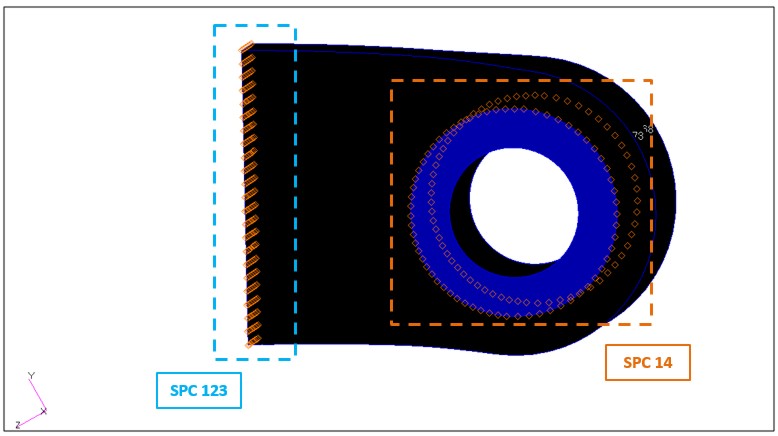
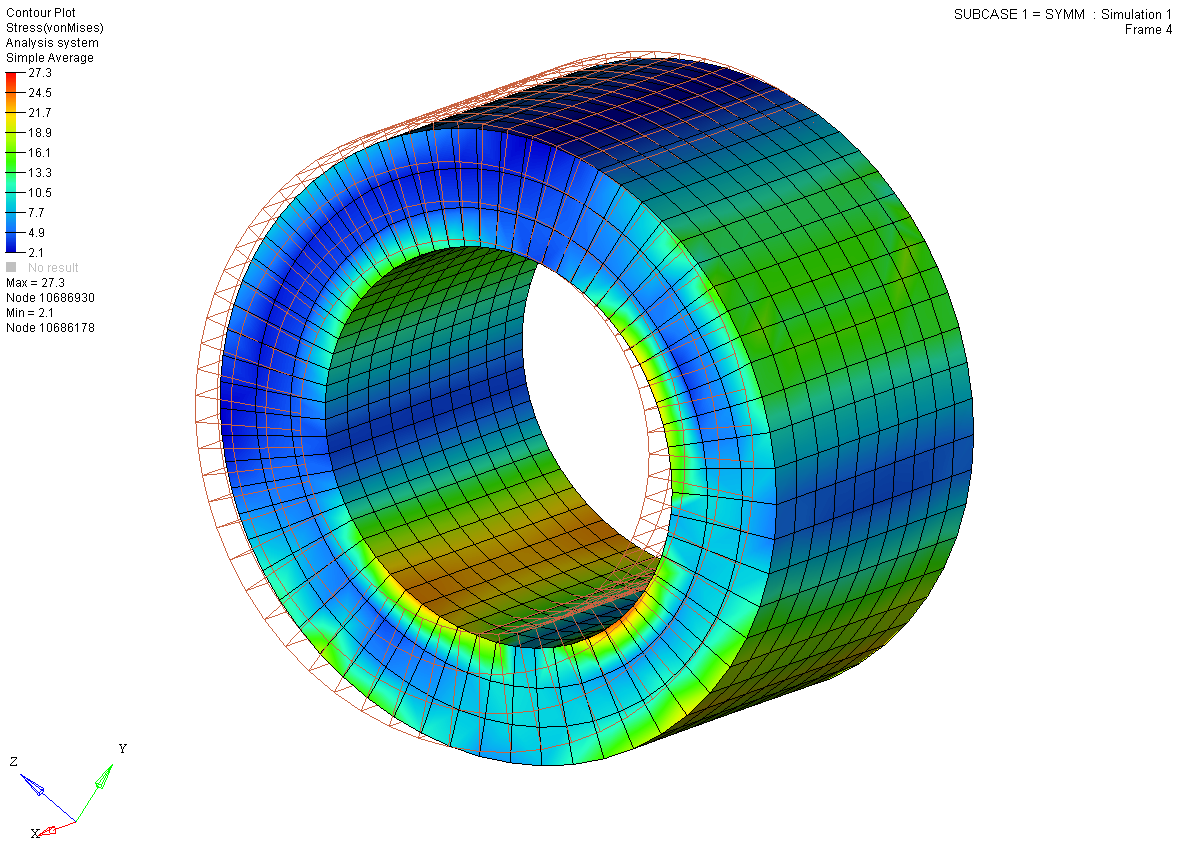
In this example (download: LUG_with_Contact_SOL101) are considered coupling between a Lug and a bush (see figure below).
For the nodes at base of Lug (highlighted in blue rectangle) there are the translations are constrained (in X,Y, Z), indeed for the nodes along the border of bush are blocked the translation in X and the rotation in X.
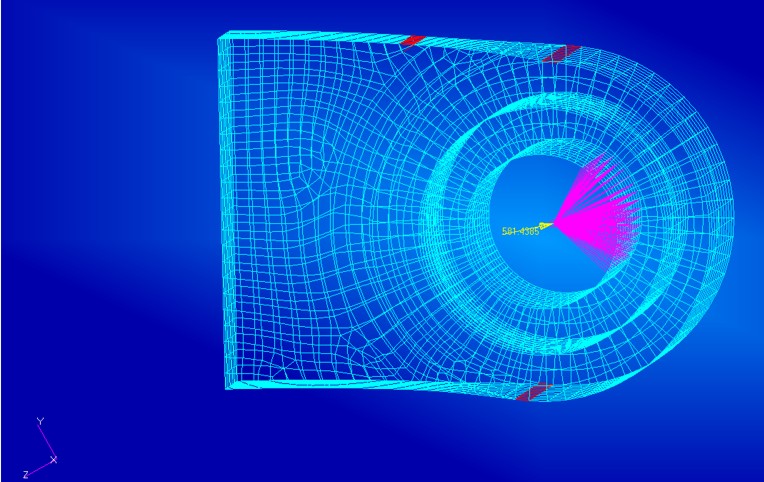
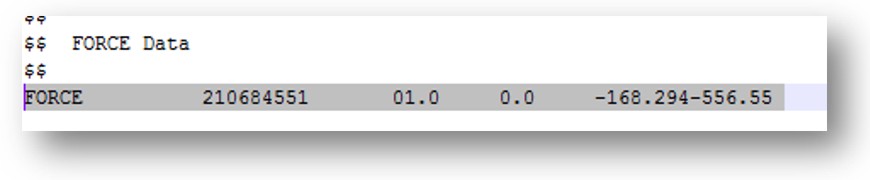
The applied force is introduced by an RBE3:
Below are summarized the steps to follow to simulate the contact with 2 bodies:
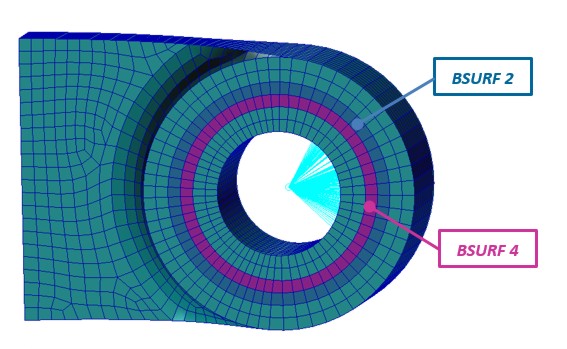
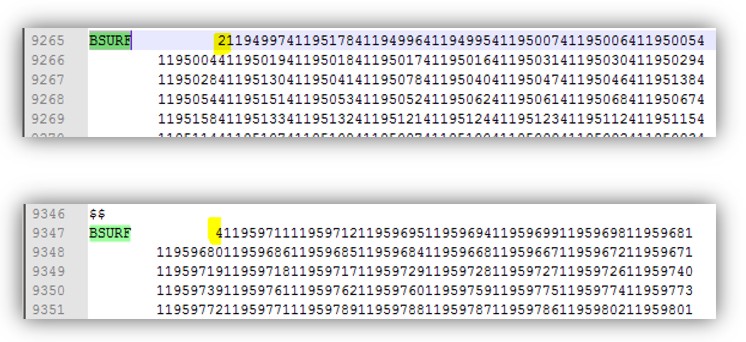
Step 1 – Create two BSURF Cards
In this cards are indicated elements and nodes interested by the contact (for 2D Elements only elements).
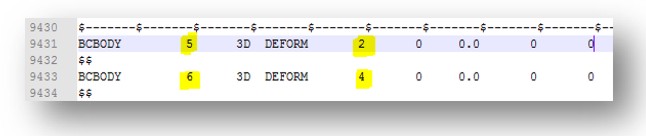
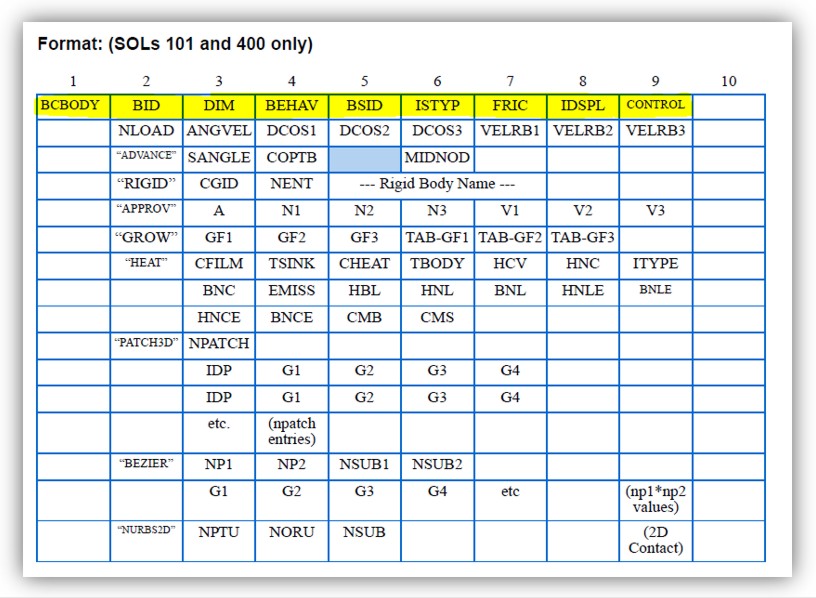
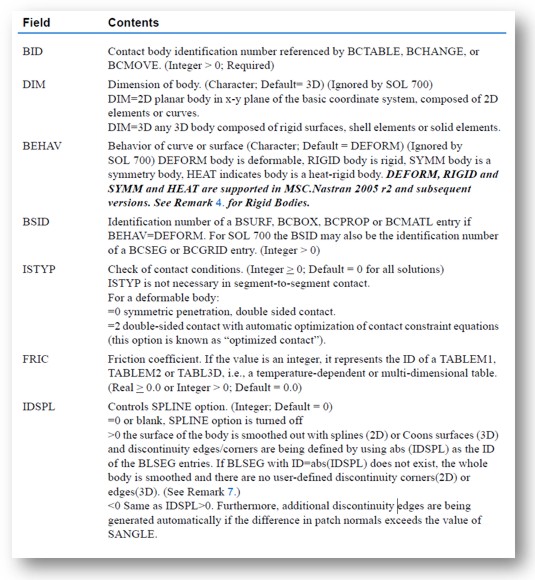
According this guide, BCBODY Defines a flexible or rigid contact body in 2D or 3D used in SOLs 101, 400, and 700 only. Below the card format (we used only the first row highlighted in yellow):
Step 3 – Create two BCTABLE Cards
In this card is defined the master surface, slave surface (BCBODY Id.), and the type of interaction; below is reported the BCTABLE of our example:
Below the Nastran format extracted from the Quick Guide:
In our case, the “Slave” is the LUG (BCBODY 5); NGROUP to indicate the continuation entries (2nd row); IGLUE Flag to activate glue option (Integer > 0), default is 0, no glue option (For SOL 700, IGLUE=1 is only acceptable).
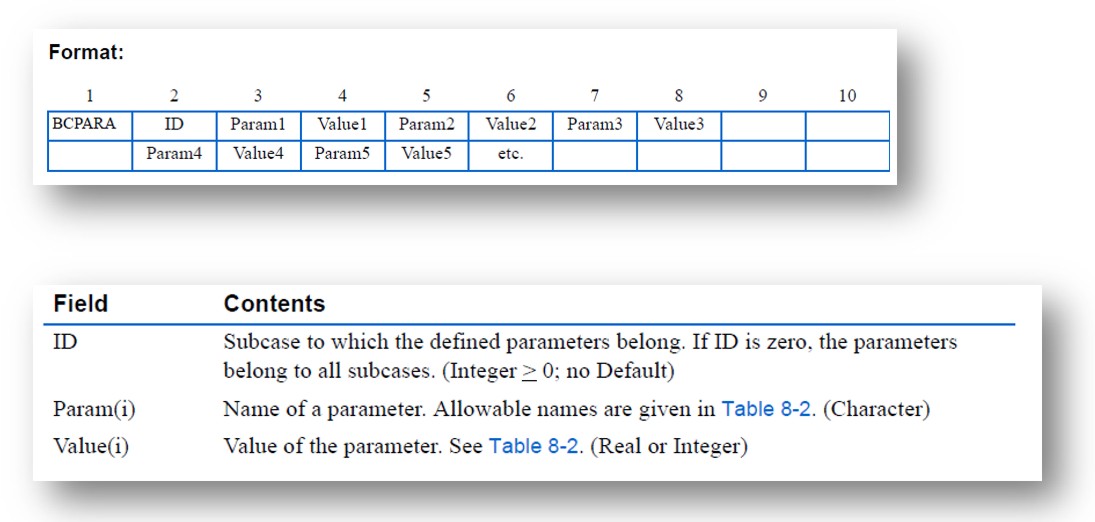
Step 4 – Create BCPARA Card with IBSEP Field active
BCPARA
Defines contact parameters used in SOL 101 and SOL 400. This entry is not available in SOL 700.
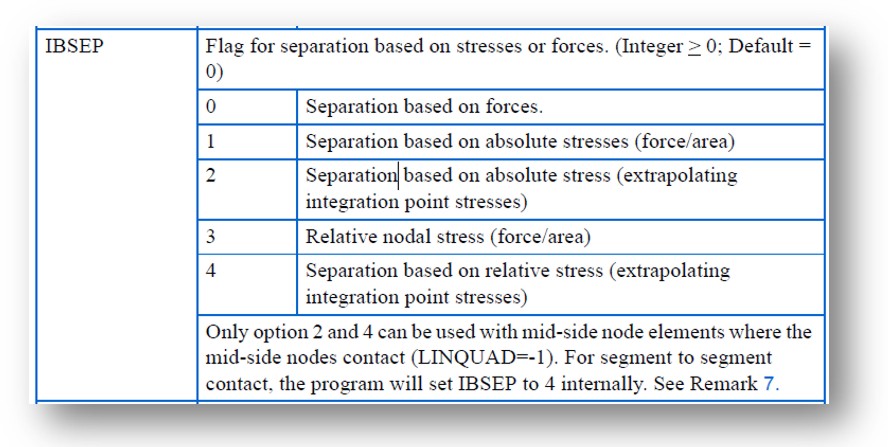
IBSEP defines the type of separation, in the example is used “1” (Separation based on absolute stresses). Below the table with all the options for BCPARA:
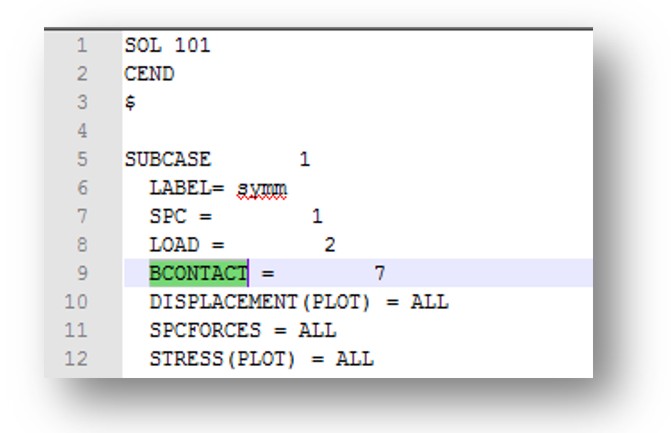
Step 5 – BCONTACT Load Definition; in this field must be indicated the BCTABLE Card Id.
By this time next year, Rolls-Royce expects to have conducted the inaugural flight of its 300-mile-per-hour, all-electric, zero-emissions plane. The project, dubbed ACCEL—short for Accelerating the Electrification of Flight—is being touted by the company as a major breakthrough for eco-friendly travel. While the process is still a ways from completion, Rolls-Royce hopes that the ACCEL plane can lay the groundwork for emissions-free aviation in the years to come.
Firmly in ACCEL’s sights is the current speed record for an all-electric plane, set at 210 miles per hour by a Siemens aircraft back in 2017. While far from the 500-600 MPH typical of today’s commercial jets, 300 miles an hour would be a significant improvement in the emissions-free space. “This plane will be powered by a state-of-the-art electrical system and the most powerful battery ever built for flight,” said project head Matheu Parr. Parr emphasized that the team’s work is yielding new insights every day given the relatively unexplored set of challenges that accompany electric flight.
Aviation and the Climate Crisis
Rolls-Royce’s effort comes amid a broader push from the aviation industry to nullify its impact on the environment. Air travel was responsible for the release of 850 million tons of carbon dioxide last year—about 2 percent of the total emissions attributable to humans. To meet this challenge, a diverse set of players has pledged its support toward greener flying initiatives. ACCEL itself is partially funded with public money from the British government, along with various partners from the private sector.
Rolls-Royce hopes to establish itself as both a pioneer and a leader in green aviation with the ACCEL project, but initiatives from other manufacturing and engineering organizations will test that title in the coming years. To cite one particularly ambitious example, easyJet has partnered with Wright Electric with the aim of bringing regular electric aircraft to some of its routes by 2027. As governments and private players alike look to tackle the climate challenge, healthy competition in developing a viable emission-free plane can only be a good thing.
iPadOS represents a bit of a shift for Apple, as it continues to differentiate how the operating system on the iPad works, feels, and functions. Now, iPadOS is available to the public, bringing with it a number of great features, including mouse support, a revamped home screen, and more.
There are plenty of features to check out, but to see them for yourself you’ll need to update your iPad. Here’s how to download iPadOS.
Compatible devices
Before installing iPadOS, you’ll need to make sure your iPad is compatible with the new operating system. Apple is known for supporting devices for a long time, but some older models won’t get the update, so it’s worth checking the list below to see if your iPad will get support.
iPad Air 2 and 3
iPad Mini 4 and 5
iPad (6th and 7th generations)
9.7-inch iPad Pro
10.5-inch iPad Pro
11-inch iPad Pro
12.9-inch iPad Pro
Downloading and installing iPadOS
Installing iPadOS onto your device is really super simple. Here’s how to get iPadOS on your iPad. Note, if you think you might not like iPadOS and might want to roll back to iOS 12, then it’s worth creating a backup before you start. Check out the instructions below on creating a backup.
Open the Settings app.
Head to General > Software Update.
Your iPad will check for updates and you should get a notification telling you that iPadOS is ready to install. Tap Download and Install.
It may take a few minutes to download and install the update, and you won’t be able to use your iPad during the update process.
Back up your iPad
Think you might want to roll back to iOS 12 after updating your device? In that case, you should make a backup before upgrading.
There are two ways to back up your iPad — using iCloud, or through iTunes.
Backing up using iCloud
Backing up your iPad using iCloud is the easiest method. Here’s how to do it for yourself.
Make sure you’re connected to a Wi-Fi network.
Open the Settings app, press your name, then tap iCloud.
Scroll down to iCloud Backup, then tap Back Up Now.
If you’re unsure as to whether the backup is complete, you can head to Settings, then tap iCloud > iCloud Storage > Manage Storage, then tap on the device on the list.
Backing up on a Mac running MacOS Catalina
MacOS Catalina no longer has iTunes, so backing up your device on a Mac is a little different than it used to be. If you’re running MacOS Catalina, you’ll instead use the Finder app. Here’s how it’s done.
Connect your iPad to your Mac.
Follow the onscreen instructions — you may need to enter a PIN code or tap Trust This Computer.
Open the Finder app and select your iPad in the sidebar.
Press the General tab, then tap Back Up Now to manually back up your iPad.
Backing up on a Mac or PC with iTunes
If you have a Mac with Mojave or older, or a PC with iTunes, then you’ll use iTunes to back up your iPad. Here’s how to do it.
Make sure you have the latest version of iTunes, then connect your iPad.
Follow the onscreen instructions — you may need to enter a PIN code or tap Trust This Computer.
Open iTunes and select your iPad.
Press the Back Up Now button to save your data.
Rolling back from iPadOS to iOS 12
If you created a backup of your device before upgrading to iPadOS, you can downgrade back to iOS 12. Here’s how to roll back from iPadOS to iOS 12.
To downgrade to iOS 12, you’ll need to put your iPad into recovery mode.
On an iPad with Face ID, hold the top button and either volume button until you see the Recovery Mode icon. On an iPad with a Home button, hold the side or top button until you see it.
Plug your iPad into your computer using the cable that came with it.
On the iTunes popup, click the Restore button.
Click Restore and Update to confirm.
An iOS 12 updater should appear. Press Next.
Click Agree to accept the Terms and Conditions.
Once the updater is finished, you’ll have a clean install of iOS 12 on your device. You’ll need to restore from your iCloud or iTunes backups to get your data back.
Follow the instructions below depending on the type of backup you made.
Restore from an iCloud backup
Here’s how to restore your device from an iCloud backup from before you updated to iOS 12.
On the Apps & Data screen, tap Restore from iCloud Backup and sign in to iCloud.
Tap Choose Backup and choose the backup you made before installing iPadOS.
Make sure you select the right backup — if you’ve had your device for more than a day, you may have another backup from when you were already on iPadOS.
Restore from an iTunes backup
Did you make an iTunes backup instead? Here’s how to restore from an iTunes backup.
Tap Restore from iTunes Backup on the Apps & Data screen.
Open iTunes on your computer, make sure your device is connected through a cable, then tap Trust This Computer.
Select your device in iTunes, then press Summary and hit the Restore Backup button.
Pick the backup from when your device was still running iOS 12.
Keep your iPad connected to your computer until after it finishes syncing.
A group of asteroids and comets caught in Jupiter’s shadow could pose a hidden menace for Earth: With stark enough changes to their orbits, the space rocks could crash into Earth or its neighbors.
That’s the conclusion of a study that identified at least one object that could experience such an orbital shift. Identifying and monitoring other objects hidden in this population could help identify potential dangers to Earth far in advance.
As the largest planet in the solar system, Jupiter hides many asteroids and comets in its shadow. Some of these, such as its moons, are gravitationally bound to the planet. Others follow a similar orbit as Jupiter itself, circling the sun. For these groupies, a high inclination, or an angle with the plane of the solar system of more than 40 degrees, is tied to a low eccentricity, giving them a nearly-circular orbit.
A recent paper examines what could happen if the stable objects orbiting near Jupiter exchange their low inclination for a high eccentricity, creating a more oval orbit. According to the author, Kenta Oshima, a researcher at the National Astronomical Observatory of Japan, such a shift could be bad news for Earth.
“We pointed out the possibility that populations of undetected potentially hazardous asteroids exist at high-inclination locations of [these objects],” Oshima wrote.
A hidden armada
Tucked in the shadow of Jupiter, many of these objects are difficult to see from Earth. Right now, while their orbits are stable, that’s not a problem. However, if their orbits shift, they could move from the safety of Jupiter onto a collision path with Earth or the other inner planets.
Once they begin to dance around Earth, they should become visible to surveys hunting for potentially dangerous objects. But their inherent danger means that astronomers should be working to identify them now, Oshima stated in his paper.
An object with a high inclination will dip in and out of the plane of the solar system that the planets orbit in, and so interactions will be few and far between. But as the inclination decreases and the object begins to spend more of its time closer to the solar system plane, the odds of a close fly-by or an impact increase.
“It is like in the case of airplanes,” Carlos de la Fuente Marcos, who studies solar system dynamics at Spain’s Complutense University of Madrid, told Space.com by email. “Flying high above the ground, they can only crash against something while landing or taking off. (De la Fuente Marcos was not part of the new research.) “But if they fly very low,” he continued, “the probability of running into a mountain or even a building increases significantly.”
Oshima has already identified one potential member of this hidden armada, 2004 AE9. The object orbits about 1.5 astronomical units (AUs; one astronomical unit is the distance between the Earth and the sun) inside the path of Jupiter.
Occasionally, the asteroid brushes past Mars on its orbits, getting as close as 0.1 AU. These fly-bys have changed the asteroid’s orbit over time. The orbit has not only drawn closer to the plane of the solar system, it has also become more eccentric. While there is no danger of it impacting Earth in the near future, 2004 AE9 may one day shift its orbit enough to leave Jupiter and collide with a rocky planet.
“Objects originally moving in highly inclined but nearly circular orbits have a low probability of impact,” de la Fuente Marcos said. “If they become unstable and inclination is traded for eccentricity, the path may become planet-crossing with a low inclination, which translates into a higher probability of impact.”
According to de la Fuente Marcos, the process would take just under a million years, a fairly rapid development in astronomical terms.
A handful of planets and comets have been identified as Jupiter co-orbitals over the last few years. (The planet has also attracted a group of bodies called the Trojan asteroids, which orbit immediately in front of and behind Jupiter, and the orbits of which are unlikely to change. But other future hazards could be hidden near the giant planet; identifying them is important.
“It is worth it to keep an eye on them, particularly cataloging them to have a census and to better know the actual size of this potentially hazardous population,” de la Fuentes said.
But the very same high-inclination paths that make them unlikely to cause problems for Earth or the inner solar system also make them challenging to find. That’s because most surveys focus on the plane of the solar system, where objects more likely to collide with Earth lie.
Whether or not the hidden objects pose a danger to the Earth remains unknown.
“If they are numerous, the danger could be potentially high, but if they are scarce the danger could be completely negligible,” de la Fuente Marcos said. “We do not yet know how many of them there are.”
The research is described in a paper published Nov. 18 in the journal Monthly Notices of the Royal Astronomical Society.
A new thermoelectric device can generate electricity for an LED light bulb even during the blackest night, according to a report by researchers.
The secret is using a phenomenon known as radiative cooling, which happens when surfaces on the ground radiate heat into the atmosphere. This process can make a surface cooler than the air surrounding it, which explains why frost forms on grass even if the air temperature is above freezing.
Researchers say their device is a useful form of renewable energy, especially because lighting demand peaks at night. “Beyond lighting, we believe this could be a broadly enabling approach to power generation suitable for remote locations, and anywhere where power generation at night is needed,” lead author Aaswath Raman, an assistant professor of materials science and engineering at the University of California, Los Angeles, said in a statement.
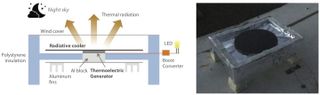
The prototype device was tested on a table 3 feet (1 meter) above the ground on a rooftop in Stanford, California, in late December. It was placed in a polystyrene enclosure covered in aluminized mylar (which minimizes thermal radiation) and protected by a wind cover. Inside the protective layers, researchers made the device draw heat from the air and send it back into the atmosphere, using a black emitter.
The researchers managed to power an LED using a voltage boost converter, and measured that over 6 hours the device can generate as much as 25 milliwatts of energy per square meter. That’s much lower than typical solar cells, but the advantage is that the device works at night, while solar cells have no sunlight to convert into energy.
The researchers say that with some modifications, the device could be used over a wider scale since the radiative cooler is simple (an aluminum disk covered in paint) and the other components are commercially available. For example, the researchers suggest increasing heat-exchange efficiency by reducing heat gain in the radiative cooling part of the device. The device may also work best in hotter and drier climates, the team noted.
A schematic of the thermoelectric generator.
(Image credit: Aaswath Raman)
“Our work highlights the many remaining opportunities for energy by taking advantage of the cold of outer space as a renewable energy resource,” Raman said. “We think this forms the basis of a complementary technology to solar. While the power output will always be substantially lower, it can operate at hours when solar cells cannot.”
This research was published Sept. 12 in the journal Joule.
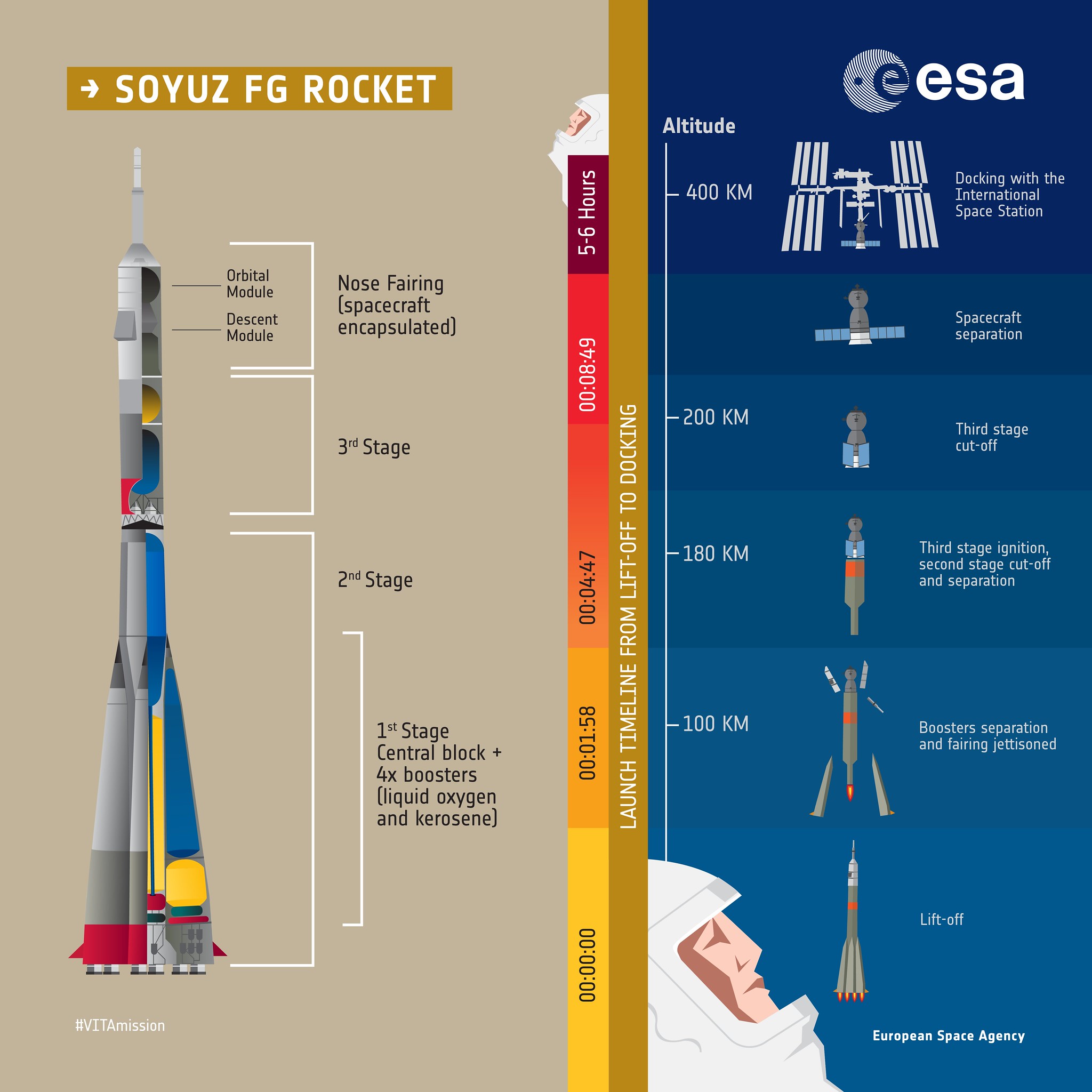
The Soyuz launcher delivers millions of horse-power to reach an orbital speed of 28 800 km/h. After the engines ignite they will propel the trio 1640 km in less than 10 minutes – averaging a 50 km/h increase every second for nine minutes.
There are three stages to reaching Earth orbit with the Soyuz rocket, each referring to a part of the rocket that uses its fuel and is then ejected to fall back to Earth.
The iconic four boosters are called the first stage. It takes only two minutes for them to burn up and deliver their thrust – by this time Paolo, Randy and Sergey will be flying 41 km high travelling at 8300 km/h and have travelled 39 km over land.
Roughly 30 seconds later the fairing and escape system is jettisoned too. The second stage has been firing all this time but runs out of fuel at roughly five minutes after liftoff. The second stage is ejected at a height of 176 km above Earth (they will have entered space by now) leaving the trio travelling at a speed of around 13 500 km/h. In just five minutes they will have travelled 500 km over land.
After the second stage is ejected the third stage ignites to give the final thrust to push our astronauts out of gravity’s reach. At almost nine minutes after liftoff the intense acceleration comes to an end when the third stage stops firing and falls back to Earth.